
by Cedar Point Realty | Dec 9, 2024 | Buying A Home
Image by Gerd Altmann from Pixabay
Are you thinking about buying a home before the year ends? You might be in for some pleasant surprises when it comes to tax benefits. Let’s dive into why closing on a home before December 31st can be a smart financial move.
1. Mortgage Interest Deduction
One of the biggest perks of homeownership is the ability to deduct mortgage interest on your tax return. If you close on your home before the end of the year, you can deduct the interest paid on your mortgage for that year. The mortgage interest deduction can significantly reduce your taxable income, especially in the early years of your mortgage when the interest payments are higher[1](https://www.fool.com/money/mortgages/articles/should-i-buy-a-house-at-the-end-of-the-year/).
2. Property Tax Deduction
Another significant benefit is the property tax deduction. Homeowners can deduct the property taxes paid on their home, which can add up to substantial savings. If you buy a house before the year ends, you can include the property taxes paid at closing in your deductions for that year[2](https://www.realtor.com/advice/buy/8-benefits-buying-a-house-years-end/).
3. Points Deduction
If you paid points to get a better rate on your mortgage, you can deduct those points on your tax return. Points are essentially prepaid interest, and they can be a significant deduction. Buying a home before the year ends means taking advantage of this deduction sooner rather than later[3](https://review42.com/resources/tax-benefits-of-buying-a-home/).
4. Energy-Efficient Home Improvements
Did you know that making energy-efficient improvements to your home can also provide tax benefits? If you buy a home and make qualifying energy-efficient upgrades before the year ends, you might be eligible for tax credits. Energy-efficient upgrades include installing solar panels, energy-efficient windows, or new insulation[4](https://www.timlewis.com/buy-a-new-home-before-the-end-of-the-year/).
5. Moving Expense Deduction
While the moving expense deduction is no longer available for most taxpayers due to changes in tax law, it’s still worth noting for specific groups. If you’re an active-duty armed forces member moving due to a military order, moving expenses can be deducted. Buying a home before the year ends can help you take advantage of this deduction for the current tax year[5](https://www.gobankingrates.com/investing/real-estate/buying-house-at-end-of-year-perks/).
6. Mortgage Insurance Deduction
If your down payment was less than 20%, you’re probably paying for private mortgage insurance (PMI). The good news is that PMI premiums are deductible. Closing on your home before the year ends means you can deduct those premiums on your tax return, reducing your taxable income.
7. Home Office Deduction
If you’re self-employed and use part of your home exclusively for business, you can take advantage of the home office deduction. The home office deductions can include some of your mortgage interest, property taxes, utilities, and repairs. Buying a home before the year ends lets you start claiming this deduction immediately.
8. Capital Gains Exclusion
While this benefit is more about selling your home, it’s worth mentioning. If you live in your home for at least two of the five years before you sell it, you can exclude up to $250,000 of capital gains from your income ($500,000 for married couples). Buying a home now sets you up to take advantage of this exclusion in the future.
9. State and Local Tax (SALT) Deduction
The SALT deduction allows you to deduct state and local taxes paid, including property taxes. While this deduction has a cap, it’s still a valuable benefit for many homeowners. Closing on a home before the year ends means you can include these taxes in your deductions for the current year.
10. Building Equity
While not a direct tax benefit, building equity in your home is a significant financial advantage. You start building equity the moment you buy so sooner is better than later. equity, which can be valuable. Plus, owning a home can provide stability and potential appreciation in value.
Conclusion
Buying a home before the year ends can offer numerous tax benefits that can save you money and help you build wealth. From mortgage interest and property tax deductions to potential credits for energy-efficient improvements, there are plenty of reasons to consider making your move before December 31st. Always consult with a tax professional to understand how these benefits apply to your specific situation and to maximize your savings.
![How Remote Work Helps with Your House Hunt [INFOGRAPHIC]](https://www.upnorthpropertysearch.com/wp-content/uploads/sites/34/2023/09/remote-work.png)
by Cedar Point Realty | Sep 22, 2023 | Buyers, Buying A Home, Infographic
Some Highlights
- While remote work peaked during the pandemic, many people still work from home today.
- If you’re one of them, it could have an unexpected benefit when you’re looking to buy a home.
- If you can work from home, you might have more choices for where to live. Connect with a real estate agent to talk about your options and what’s most important to you.

by Cedar Point Realty | Aug 22, 2023 | Buyers, Buying A Home, Interest Rates
If you remember the housing crash back in 2008, you may recall just how popular adjustable-rate mortgages (ARMs) were back then. And after years of being virtually nonexistent, more people are once again using ARMs when buying a home. Let’s break down why that’s happening and why this isn’t cause for concern.
Why ARMs Have Gained Popularity More Recently
This graph uses data from the Mortgage Bankers Association (MBA) to show how the percentage of adjustable-rate mortgages has increased over the past few years:
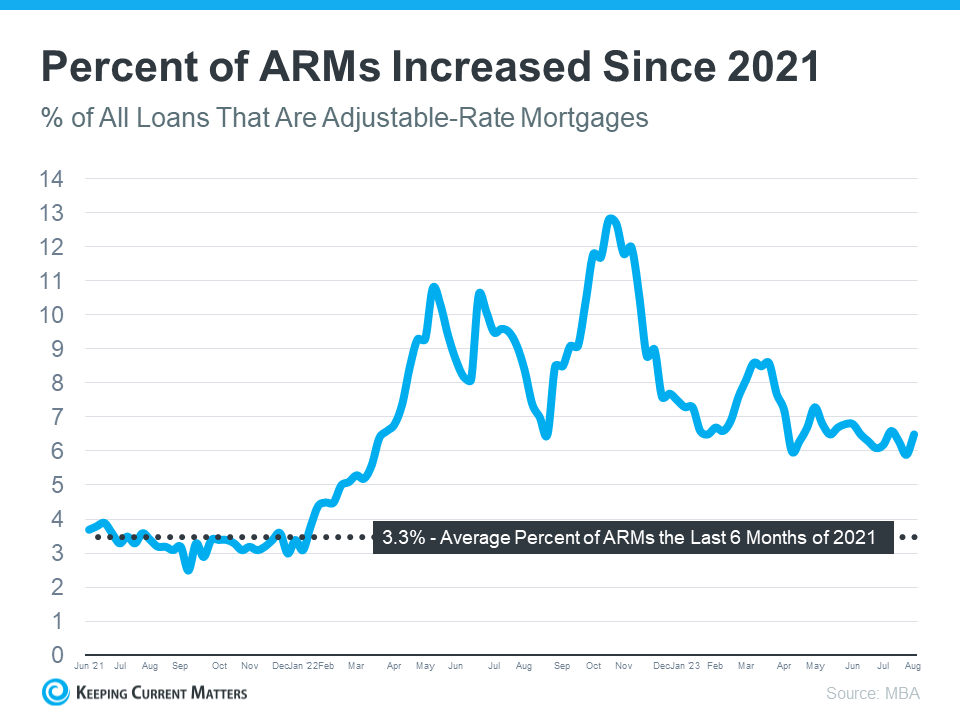
As the graph conveys, after hovering around 3% of all mortgages in 2021, many more homeowners turned to adjustable-rate mortgages again last year. There’s a simple explanation for that increase. Last year is when mortgage rates climbed dramatically. With higher borrowing costs, some homeowners decided to take out this type of loan because traditional borrowing costs were high, and an ARM gave them a lower rate.
Why Today’s ARMs Aren’t Like the Ones in 2008
To put things into perspective, let’s remember these aren’t like the ARMs that became popular leading up to 2008. Part of what caused the housing crash was loose lending standards. Back then, when a buyer got an ARM, banks and lenders didn’t require proof of their employment, assets, income, etc. Basically, people were getting loans that they shouldn’t have been awarded. This set many homeowners up for trouble because they couldn’t pay back the loans that they never had to qualify for in the first place.
This time around, lending standards are different. Banks and lenders learned from the crash, and now they verify income, assets, employment, and more. This means today’s buyers actually have to qualify for their loans and show they’ll be able to repay them.
Archana Pradhan, Economist at CoreLogic, explains the difference between then and now:
“Around 60% of Adjustable-Rate Mortgages (ARM) that were originated in 2007 were low- or no-documentation loans . . . Similarly, in 2005, 29% of ARM borrowers had credit scores below 640 . . . Currently, almost all conventional loans, including both ARMs and Fixed-Rate Mortgages, require full documentation, are amortized, and are made to borrowers with credit scores above 640.”
In simple terms, Laurie Goodman at Urban Institute helps drive this point home by saying:
“Today’s Adjustable-Rate Mortgages are no riskier than other mortgage products and their lower monthly payments could increase access to homeownership for more potential buyers.”
Bottom Line
If you’re worried today’s adjustable-rate mortgages are like the ones from the housing crash, rest assured, things are different this time.
And, if you’re a first-time homebuyer and you’d like to learn more about lending options that could help you overcome today’s affordability challenges, reach out to a trusted lender.

by Cedar Point Realty | Apr 28, 2021 | Buying A Home, Buying Myth, Housing Market Updates
The question many homebuyers are facing this year is, “Why is it so hard to find a house?” We’re in the ultimate sellers’ market, which means real estate is ultra-competitive for buyers right now. The National Association of Realtors (NAR) notes homes are getting an average of 4.8 offers per sale, and that number keeps rising. Why? It’s because there are so few houses for sale.
Low inventory in the housing market isn’t new, but it’s becoming more challenging to navigate. Danielle Hale, Chief Economist at realtor.com, explains:
“The housing market is still relatively under supplied, and buyers can’t buy what’s not for sale. Relative to what we saw in 2017 to 2019, March 2021 was still roughly 117,000 new listings lower, adding to the pre-existing early-year gap of more than 200,000 fresh listings that would typically have come to market in January or February. Despite this week’s gain from a year ago, we’re 19 percent below the new seller activity that we saw in the same week in 2019.”
While many homeowners paused their plans to sell during the height of the pandemic, this isn’t the main cause of today’s huge gap between supply and demand. Sam Khater, Vice President and Chief Economist at Freddie Mac, Economic Housing and Research Division, shares:
“The main driver of the housing shortfall has been the long-term decline in the construction of single-family homes . . . That decline has resulted in the decrease in supply of entry-level single-family homes or, ’starter homes.’”
When you consider the number of homes built in the U.S. by decade, the serious lack of new construction is clear (See graph below):

The number of newly built homes is disproportionately lower than the rate of household formation, which, according to the U.S. Census Bureau, has continued to increase. Khater also explains:
“Even before the COVID-19 pandemic and current recession, the housing market was facing a substantial supply shortage and that deficit has grown. In 2018, we estimated that there was a housing supply shortage of approximately 2.5 million units, meaning that the U.S. economy was about 2.5 million units below what was needed to match long-term demand. Using the same methodology, we estimate that the housing shortage increased to 3.8 million units by the end of 2020. A continued increase in a housing shortage is extremely unusual; typically in a recession, housing demand declines and supply rises, causing inventory to rise above the long-term trend.”
To catch up to current demand, Freddie Mac estimates we need to build almost four million homes. The good news is builders are working hard to get us there. The U.S. Census Bureau also states:
“Privately-owned housing units authorized by building permits in March were at a seasonally adjusted annual rate of 1,766,000. This is 2.7 percent (±1.7 percent) above the revised February rate of 1,720,000 . . . Privately-owned housing starts in March were at a seasonally adjusted annual rate of 1,739,000. This is 19.4 percent (±13.7 percent) above the revised February estimate of 1,457,000. . . .”
What does this mean? Lawrence Yun, Chief Economist at NAR, clarifies:
“The March figure of 1.74 million housing starts is the highest in 14 years. Both single-family units and multifamily units ramped up. After 13 straight years of underproduction – the chief cause for today’s inventory shortage – this construction boom needs to last for at least three years to make up for the part shortfall. As trade-up buyers purchase newly constructed homes, their prior homes will show up in MLSs, and hence, more choices for consumers. Housing starts to housing completion could be 4 to 8 months, so be patient with the improvement to inventory. In the meantime, construction workers deserve cheers.”
Bottom Line
If you’re planning to buy this year, the key to success will be patience, given today’s low inventory environment. Let’s connect today to talk more about what’s happening in our area.

by Cedar Point Realty | Mar 1, 2021 | Buyers, Buyers & Sellers, Buying A Home, Buying Myth, Housing Market Updates
If you’re thinking of buying a home this year, you may be wondering how much money you need to come up with for your down payment. Many people may think it’s 20% of the loan to secure a mortgage. While there are plenty of lower down payment options available for qualified buyers who don’t want to put 20% down, it’s important to understand how a larger down payment can have great benefits too.
The truth is, there are many programs available that allow you to put down as little as 3.5%, which can be a huge benefit to those who want to purchase a home sooner rather than later. Those who have served our country may also qualify for a Veterans Affairs Home Loan (VA) and may not need a down payment. These programs have really cut down the savings time for many potential buyers, enabling them to start building family wealth sooner.
Here are four reasons why putting 20% down is a good plan if you can afford it.
1. Your interest rate may be lower.
A 20% down payment vs. a 3-5% down payment shows your lender you’re more financially stable and not a large credit risk. The more confident your lender is in your credit score and your ability to pay your loan, the lower the mortgage interest rate they’ll likely be willing to give you.
2. You’ll end up paying less for your home.
The larger your down payment, the smaller your loan amount will be for your mortgage. If you’re able to pay 20% of the cost of your new home at the start of the transaction, you’ll only pay interest on the remaining 80%. If you put down 5%, the additional 15% will be added to your loan and will accrue interest over time. This will end up costing you more over the lifetime of your home loan.
3. Your offer will stand out in a competitive market.
In a market where many buyers are competing for the same home, sellers like to see offers come in with 20% or larger down payments. The seller gains the same confidence as the lender in this scenario. You are seen as a stronger buyer with financing that’s more likely to be approved. Therefore, the deal will be more likely to go through.
4. You won’t have to pay Private Mortgage Insurance (PMI)
What is PMI? According to Freddie Mac:
“PMI is an insurance policy that protects the lender if you are unable to pay your mortgage. It’s a monthly fee, rolled into your mortgage payment, that is required for all conforming, conventional loans that have down payments less than 20%. Once you’ve built equity of 20% in your home, you can cancel your PMI and remove that expense from your mortgage payment.”
As mentioned earlier, when you put down less than 20% when buying a home, your lender will see your loan as having more risk. PMI helps them recover their investment in you if you’re unable to pay your loan. This insurance isn’t required if you’re able to put down 20% or more.
Many times, home sellers looking to move up to a larger or more expensive home are able to take the equity they earn from the sale of their house to put down 20% on their next home. With the equity homeowners have today, it creates a great opportunity to put those savings toward a 20% or greater down payment on a new home.
If you’re looking to buy your first home, you’ll want to consider the benefits of 20% down versus a smaller down payment option.
Bottom Line
If you’re thinking of buying a home and are already saving for your down payment, let’s connect to discuss what fits best with your long-term plans.

by Cedar Point Realty | Dec 1, 2020 | Buyers, Buying A Home, Buying Myth, Demographics, Downpayments, First Time Home Buyers, Interest Rates
Homeownership is on the goal list for many young adults, but sometimes it’s hard to know exactly how to get there. From understanding the homebuying process to pre-approval and down payment assistance options, uncertainty along the way can ultimately hold some buyers back.
Today, there are over 75 million Millennials and 67 million Gen Z’ers in the U.S., making up a significant number of both current and soon-to-be homebuyers. According to a recent Fannie Mae survey of more than 2,000 of these individuals:
“88% said they are confident they will achieve homeownership someday.”
In addition, the survey also reveals that for younger generations, the motivation to own a home may be more emotional than financial compared to previous generations:
- <50% say they want to use their home as an asset
- 78% believe it’s the best way to live the way they want, without restrictions
- 80% believe homeownership is the best way to make it on their own
Whether homeownership goals come from the heart or are driven by financial aspirations (or maybe both), the obstacles standing in the way don’t have to bring these dreams to a screeching halt. The same survey also reveals two key roadblocks for potential buyers. Thankfully, they’re both easily overcome with the power of knowledge and trusted advisors leading the way. Here’s a look at these two challenges potential homebuyers face today:
1. 73% of future homebuyers are unaware of low-down-payment mortgage options
For those who want to purchase a home, low-down-payment options are instrumental to affording one sooner rather than later, especially given the amount of debt many younger adults have accumulated. Fannie Mae also notes:
“Among the challenges they face is an unprecedented amount of debt, along with a lack of understanding of the mortgage process and their own purchasing power. Debt, in particular, creates many obstacles such as a limited ability to save and the fear of taking on more debt.”
Today, there are more than 2,340 down payment assistance programs available nationwide to help relieve this pressure. Understanding what’s out there and the options available may help many buyers become homeowners faster than they thought possible. In a year like this, with record-low mortgage rates making their mark in the history books, being able to take advantage of the opportunity buyers have right now is essential to long-term affordability.
2. 64% of buyers expect lenders and other real estate professionals to educate them about the mortgage process
While many people love to do a quick search online to find instant answers to their questions, it isn’t the only way younger generations want to consume information or build their knowledge base. As the survey mentions, having trusted professionals help them learn what it takes to achieve their dreams is definitely on their wish list too.
Bottom Line
If you’re aiming for homeownership someday, it may be in closer reach than you think. Let’s connect so you can learn about the process and get the guidance you need to make it happen.
