
by Cedar Point Realty | Mar 25, 2025 | Housing Market Updates
The housing market has been in flux for several years, with skyrocketing home prices, limited inventory, and rising mortgage rates. But in 2025, things are starting to stabilize. Buyers and sellers alike are wondering if the market is finally starting to balance out. In this article, we’ll explore the key trends that suggest a more balanced housing market may be emerging.
Key Factors Shaping the Housing Market
Several factors are contributing to the market’s shift from a seller-driven frenzy to a more balanced environment. Here’s what’s happening.
1. Home Prices Are Stabilizing
Home prices have been on the rise for years, making it difficult for many buyers to afford a home. But recently, the rapid price increases have slowed. While prices aren’t drastically falling, they’ve stopped escalating at the same pace. This price stabilization is a welcome sign for buyers who are looking for more affordable options.
2. Higher Mortgage Rates
Mortgage rates have increased significantly over the past year. While higher rates can make buying a home more expensive, they also have a cooling effect on demand. With borrowing costs higher, fewer buyers are willing to jump into the market, allowing the supply and demand to balance out.
3. More Homes for Sale
One of the biggest challenges in recent years has been the shortage of homes for sale. However, more homes are now being listed, which is helping to alleviate this inventory shortage. With more options available, buyers have more choices and face less competition.
4. Sellers Adjusting Expectations
Sellers who previously expected to sell their homes for top dollar are becoming more realistic. As competition cools and inventory increases, homes are staying on the market longer. Many sellers are adjusting their prices and offering more flexible negotiations to meet the market’s new demands.
5. Slower Sales Pace
The pace of home sales has slowed due to higher mortgage rates and economic uncertainty. Homes are staying on the market for longer periods, giving buyers more time to make decisions without the pressure of multiple offers or bidding wars.
What Does This Mean for Buyers?
For homebuyers, the shift in the market offers several advantages:
- More Inventory to Choose From: With more homes available, buyers can afford to be more selective. There’s less pressure to make a rushed decision.
- Price Stability: While home prices aren’t dropping significantly, they’re not rising at the same rapid pace. This creates more affordable options for buyers.
- Less Competition: Fewer bidding wars mean buyers can negotiate better terms, without having to outbid other offers.
What Does This Mean for Sellers?
For sellers, the current market dynamics require some adjustments:
- Realistic Pricing: Sellers can still sell for a competitive price, but they need to be realistic. Overpricing can lead to extended time on the market.
- More Time to Sell: Homes may take longer to sell in this more balanced market. Sellers should be prepared for a slower sales process.
- Negotiation Flexibility: With more buyers having options, sellers may need to be more flexible with terms, such as lowering the price or making repairs to secure a deal.
Conclusion
The housing market is showing signs of balancing out. With stabilizing home prices, rising mortgage rates, and more inventory becoming available, both buyers and sellers are adjusting to a more moderate market. Buyers are benefiting from more options and less competition, while sellers are facing a need for more realistic pricing and negotiations.
If you’re planning to buy or sell a home, the current market offers a more balanced playing field, making it a good time to make a move. Whether you’re a buyer looking for more affordable options or a seller adjusting to new market conditions, now may be the right time to take action.

by Cedar Point Realty | Dec 23, 2024 | Advice for Buyers, Housing Market Updates
So, you’re considering buying a home in this pricey market? Well, the first thing you must do is figure out how much house you can afford. And once you’ve got that number, stick to it! Don’t let the pressure of seeing other buyers snatch up homes make you overspend.
I get it; waiting for the right home that fits your budget can test patience. But trust me, you’ll be thanking yourself later when your home feels like a blessing, not a burden with a hefty mortgage payment you’re struggling to afford!
Here are a few tips to help you feel confident about buying a home this year:
- Keep your house payment to 25% or less of your monthly take-home pay: This includes everything – principal, interest, property tax, home insurance, homeowners association (HOA) fees, and if your down payment is lower than 20%, private mortgage insurance (PMI). That’s an extra fee added to your mortgage to protect your lender (not you) if you don’t make payments.
- Save a significant down payment: Ideally, you’ll want to save a down payment of at least 20% to avoid PMI. If you’re a first-time home buyer, a smaller down payment, like 5% to 10%, is okay too—but then you’ll have to pay PMI. Saving a significant down payment is doable! You have to stay patient and focused. Who knows, you might even be able to save a five-figure down payment (or more) by this time next year.
- Choose a 15-year fixed-rate conventional mortgage: The best home loan (and the only one I recommend) is a 15-year fixed-rate mortgage. Avoid expensive options like the 30-year mortgage, FHA, VA, USDA, and adjustable-rate mortgages. They’ll charge you tens of thousands of dollars extra in interest and fees and keep you in debt for decades.
Once you’re ready to buy, you’ll need to start working with an experienced real estate agent who’s an expert in your local area. You might be tempted to go the DIY route, but that’s not a good idea. A good agent will help you navigate the ins and outs of the buying process and take a lot of stress (and complicated paperwork!) off your shoulders.
So, there you have it! Navigating a high-priced market might seem daunting, but with these strategies, you’ll be well-equipped to find a home that suits your needs. Happy house hunting!

by Cedar Point Realty | Apr 4, 2024 | Baby Boomers, Demographics, Housing Market Updates
Have you heard the term “Silver Tsunami” getting tossed around recently? If so, here’s what you really need to know. That phrase refers to the idea that a lot of baby boomers are going to move or downsize all at once. And the fear is that a sudden influx of homes for sale would have a big impact on housing. That’s because it would create a whole lot more competition for smaller homes and would throw off the balance of supply and demand, which ultimately would impact home prices.
But here’s the thing. There are a couple of faults in that logic. Let’s break them down and put your mind at ease.
Not All Baby Boomers Plan To Move
For starters, plenty of baby boomers don’t plan on moving at all. A study from the AARP says more than half of adults aged 65 and older want to stay in their homes and not move as they age (see graph below):
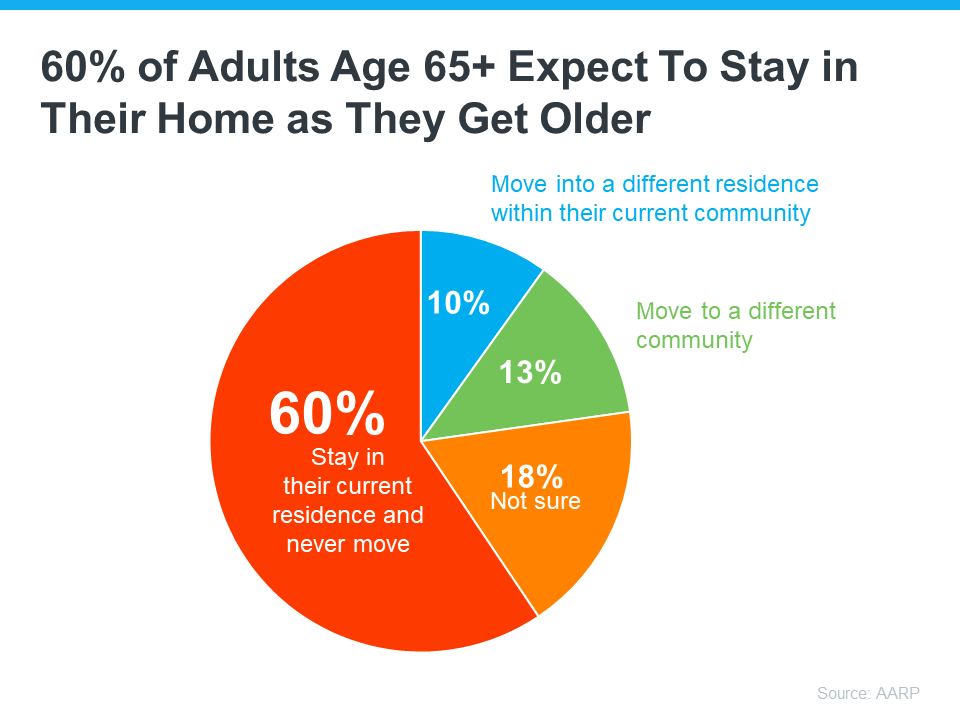
While it’s true circumstances may change and some people who don’t plan to move (the red in the chart above) may realize they need to down the road, the vast majority are counting on aging in place.
As for those who stay put, they’ll likely modify their homes as their needs change over time. And when updating their existing home won’t work, some will buy a second home and keep their original one as an investment to fuel generational wealth for their loved ones. As an article from Inman explains:
“Many boomers have no desire to retire fully and take up less space . . . Many will modify their current home, and the wealthiest will opt to have multiple homes.”
Even Those Who Do Move Won’t Do It All at Once
While not all baby boomers are looking to sell their homes and move – the ones who do won’t all do it at the same time. Instead, it’ll happen slowly over many years. As Freddie Mac says:
“We forecast the ‘tsunami’ will be more like a tide, bringing a gradual exit of 9.2 million Boomers by 2035 . . .”
As Mark Fleming, Chief Economist at First American, says:
“Demographics are never a tsunami. The baby boomer generation is almost two decades of births. That means they’re going to take about two decades to work their way through.”
Bottom Line
If you’re stressed about a Silver Tsunami shaking the housing market overnight, don’t be. Baby boomers will move slowly over a much longer period of time.
![The Latest Trends in Housing [INFOGRAPHIC]](https://www.upnorthpropertysearch.com/wp-content/uploads/sites/34/2024/03/The-Latest-National-Trends-in-Housing-NM.jpg)
by Cedar Point Realty | Mar 15, 2024 | For Sellers, Housing Market Updates, Infographic

Some Highlights

by Cedar Point Realty | Mar 5, 2024 | Foreclosures, Housing Market Updates
There’s been a lot of recession talk over the past couple of years. And that may leave you worried we’re headed for a repeat of what we saw back in 2008. Here’s a look at the latest expert projections to show you why that isn’t going to happen.
According to Jacob Channel, Senior Economist at LendingTree, the economy’s pretty strong:
“At least right now, the fundamentals of the economy, despite some hiccups, are doing pretty good. While things are far from perfect, the economy is probably doing better than people want to give it credit for.”
That might be why a recent survey from the Wall Street Journal shows only 39% of economists think there’ll be a recession in the next year. That’s way down from 61% projecting a recession just one year ago (see graph below):
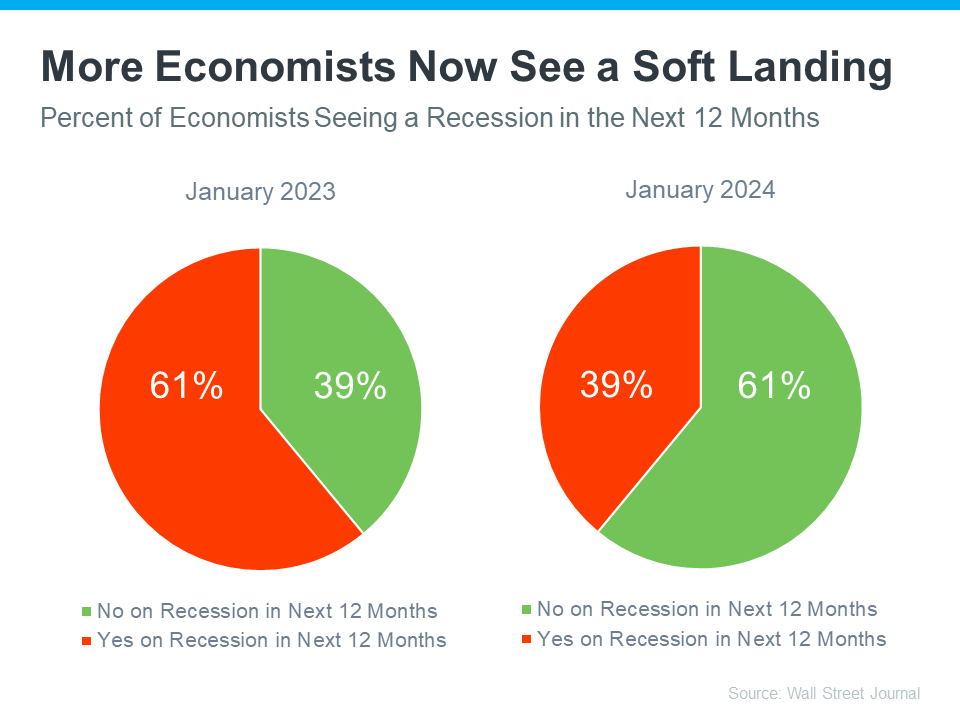
Most experts believe there won’t be a recession in the next 12 months. One reason why is the current unemployment rate. Let’s compare where we are now with historical data from Macrotrends, the Bureau of Labor Statistics (BLS), and Trading Economics. When we do, it’s clear the unemployment rate today is still very low (see graph below):
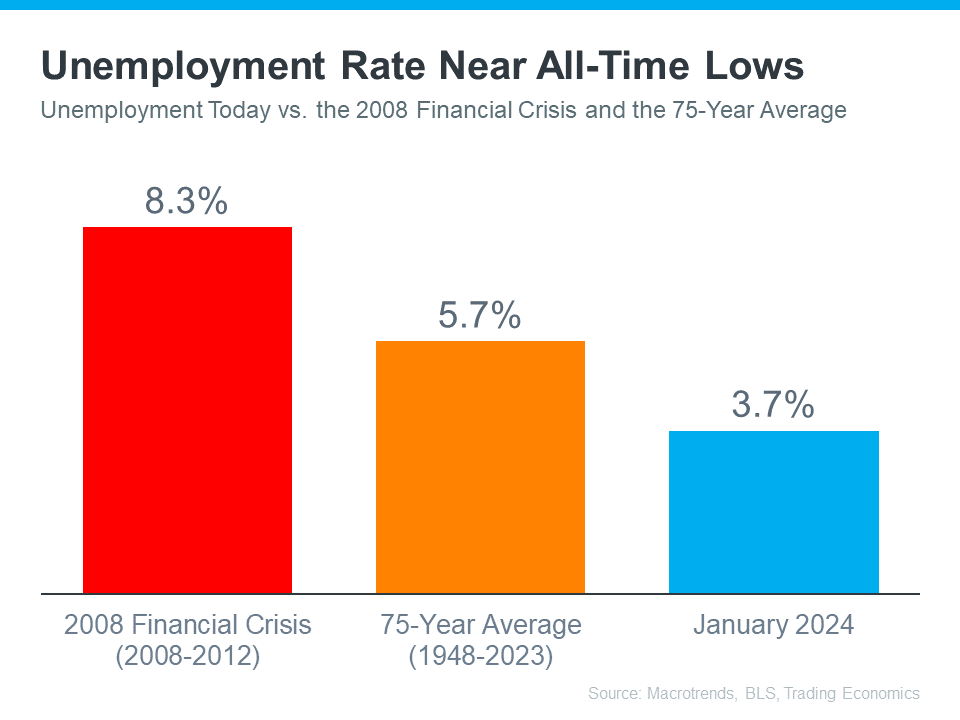
The orange bar shows the average unemployment rate since 1948 is about 5.7%. The red bar shows that right after the financial crisis in 2008, when the housing market crashed, the unemployment rate was up to 8.3%. Both of those numbers are much larger than the unemployment rate this January (shown in blue).
But will the unemployment rate go up? To answer that, look at the graph below. It uses data from that same Wall Street Journal survey to show what the experts are projecting for unemployment over the next three years compared to the long-term average (see graph below):
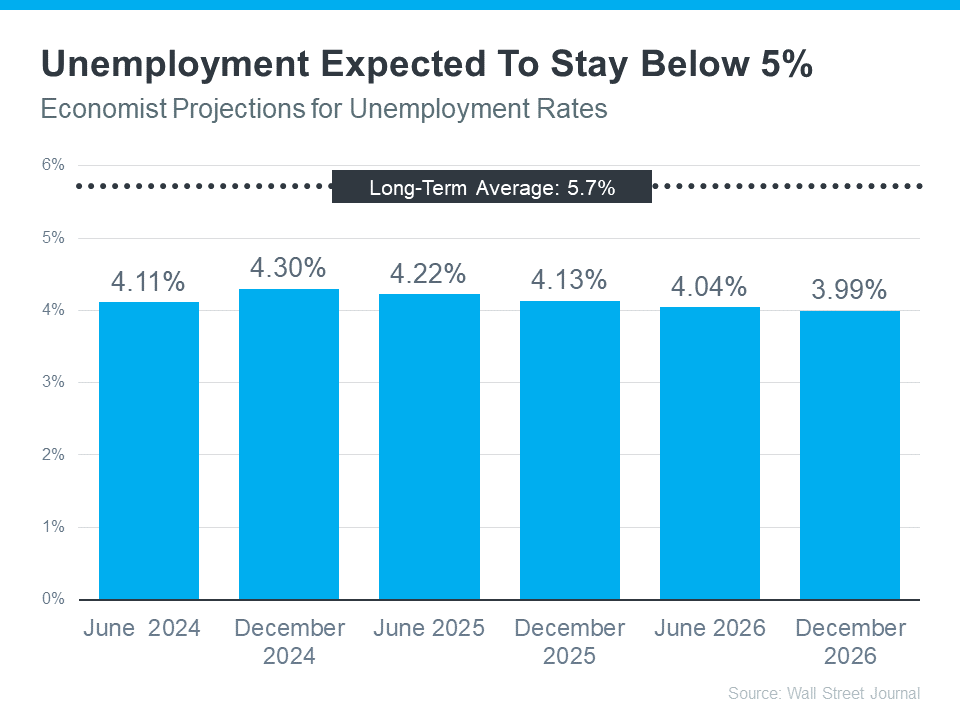
As you can see, economists don’t expect the unemployment rate to even come close to the long-term average over the next three years – much less the 8.3% we saw when the market last crashed.
Still, if these projections are correct, there will be people who lose their jobs next year. Anytime someone’s out of work, that’s a tough situation, not just for the individual, but also for their friends and loved ones. But the big question is: will enough people lose their jobs to create a flood of foreclosures that could crash the housing market?
Looking ahead, projections show the unemployment rate will likely stay below the 75-year average. That means you shouldn’t expect a wave of foreclosures that would impact the housing market in a big way.
Bottom Line
Most experts now think we won’t have a recession in the next year. They also don’t expect a big jump in the unemployment rate. That means you don’t need to fear a flood of foreclosures that would cause the housing market to crash.

by Cedar Point Realty | Feb 29, 2024 | Housing Market Updates, Interest Rates, Pricing
If you’re holding out hope that the housing market is going to crash and bring home prices back down, here’s a look at what the data shows. And spoiler alert: that’s not in the cards. Instead, experts say home prices are going to keep going up.
Today’s market is very different than it was before the housing crash in 2008. Here’s why.
It’s Harder To Get a Loan Now – and That’s Actually a Good Thing
It was much easier to get a home loan during the lead-up to the 2008 housing crisis than it is today. Back then, banks had different lending standards, making it easy for just about anyone to qualify for a home loan or refinance an existing one.
Things are different today. Homebuyers face increasingly higher standards from mortgage companies. The graph below uses data from the Mortgage Bankers Association (MBA) to show this difference. The lower the number, the harder it is to get a mortgage. The higher the number, the easier it is:
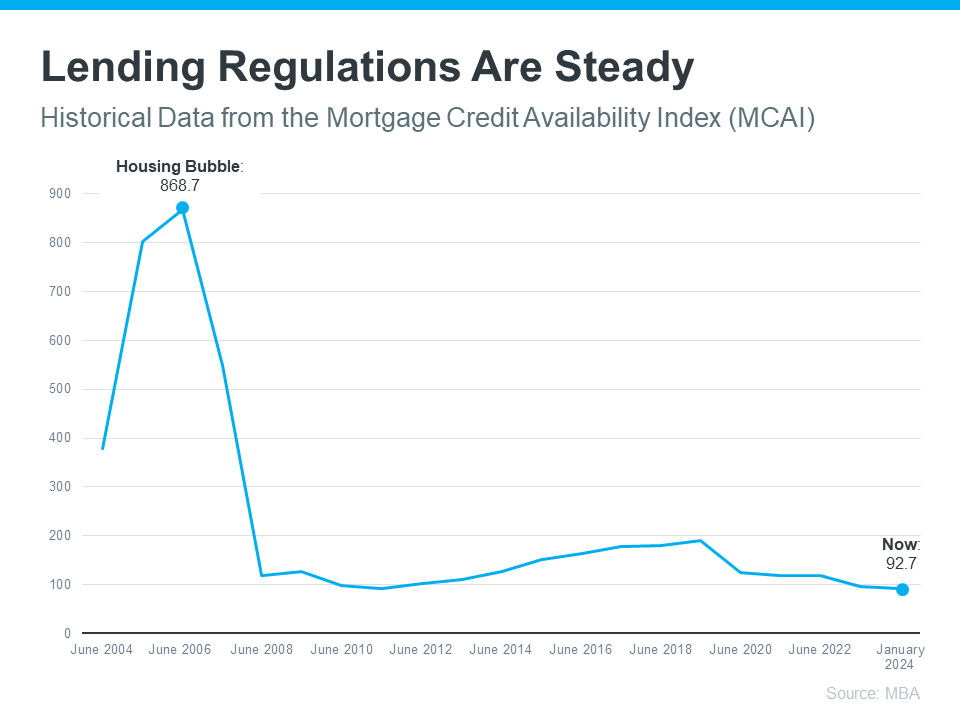
The peak in the graph shows that, back then, lending standards weren’t as strict as they are now. That means lending institutions took on much greater risk in both the person and the mortgage products offered around the crash. That led to mass defaults and a flood of foreclosures coming onto the market.
There Are Far Fewer Homes for Sale Today, so Prices Won’t Crash
Because there were too many homes for sale during the housing crisis (many of which were short sales and foreclosures), that caused home prices to fall dramatically. But today, there’s an inventory shortage – not a surplus.
The graph below uses data from the National Association of Realtors (NAR) and the Federal Reserve to show how the months’ supply of homes available now (shown in blue) compares to the crash (shown in red):
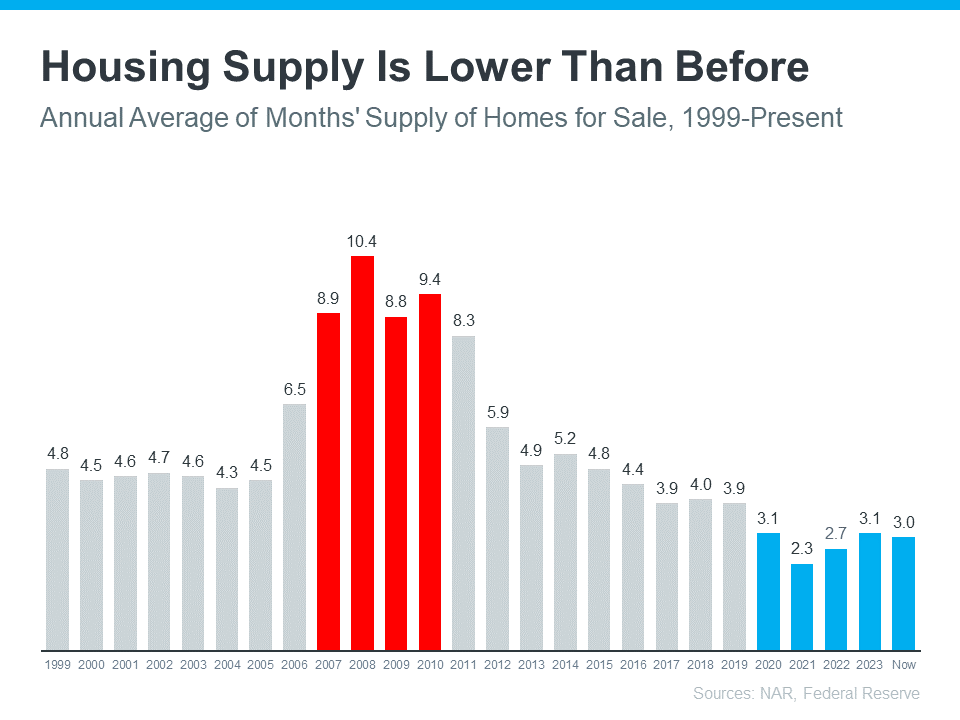
Today, unsold inventory sits at just a 3.0-months’ supply. That’s compared to the peak of 10.4 month’s supply back in 2008. That means there’s nowhere near enough inventory on the market for home prices to come crashing down like they did back then.
People Are Not Using Their Homes as ATMs Like They Did in the Early 2000s
Back in the lead up to the housing crash, many homeowners were borrowing against the equity in their homes to finance new cars, boats, and vacations. So, when prices started to fall, as inventory rose too high, many of those homeowners found themselves underwater.
But today, homeowners are a lot more cautious. Even though prices have skyrocketed in the past few years, homeowners aren’t tapping into their equity the way they did back then.
Black Knight reports that tappable equity (the amount of equity available for homeowners to access before hitting a maximum 80% loan-to-value ratio, or LTV) has actually reached an all-time high:
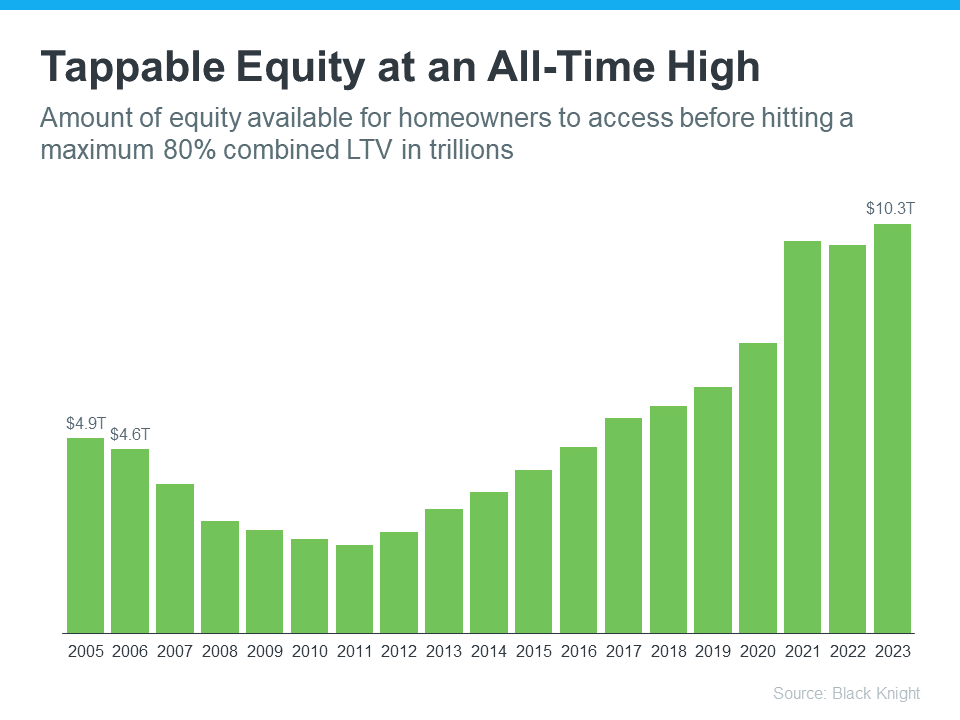
That means, as a whole, homeowners have more equity available than ever before. And that’s great. Homeowners are in a much stronger position today than in the early 2000s. That same report from Black Knight goes on to explain:
“Only 1.1% of mortgage holders (582K) ended the year underwater, down from 1.5% (807K) at this time last year.”
And since homeowners are on more solid footing today, they’ll have options to avoid foreclosure. That limits the number of distressed properties coming onto the market. And without a flood of inventory, prices won’t come tumbling down.
Bottom Line
While you may be hoping for something that brings prices down, that’s not what the data tells us is going to happen. The most current research clearly shows that today’s market is nothing like it was last time.
