
by Cedar Point Realty | Jan 9, 2025 | Agent Value, For Sellers, Foreclosures
When financial challenges arise, homeowners can face the daunting prospect of missing mortgage payments or even losing their homes to foreclosure. Thankfully, mortgage forbearance provides a valuable option for those experiencing temporary hardship. This article explores how mortgage forbearance works, its benefits and drawbacks, and when it may be the right solution for homeowners in need of assistance.
What Is Mortgage Forbearance?
Mortgage forbearance is a temporary agreement between a homeowner and their lender that allows for the suspension or reduction of mortgage payments. This option is especially helpful when a homeowner is going through a temporary financial hardship, such as a job loss, medical emergency, or natural disaster, and is unable to make regular payments. The forbearance period can last anywhere from a few months to up to a year, depending on the lender and the borrower’s specific circumstances.
While forbearance provides short-term relief, it is important to understand that it is not a permanent solution. The homeowner is still obligated to repay the amount deferred, and the lender may add missed payments back onto the loan balance after the forbearance period ends.
How Mortgage Forbearance Works
When a homeowner enters into forbearance, they may receive one of several types of relief:
- Suspension of Payments: The homeowner does not have to make any mortgage payments for a set period of time.
- Reduced Payments: The homeowner may make smaller, more manageable payments during the forbearance period.
Once the forbearance period ends, the homeowner must work with the lender to address the missed payments. Repayment options typically include:
- Deferring Payments to the End of the Loan Term: The missed payments are added to the back end of the loan, extending the mortgage term.
- Lump-Sum Repayment: The borrower may be required to pay the missed payments in one large payment, potentially leading to financial strain.
- Modified Payment Schedule: The deferred payments may be spread out over the remaining life of the loan, resulting in slightly higher monthly payments.
During forbearance, interest may still accrue on the loan, meaning the overall balance of the mortgage can increase.
When to Consider Mortgage Forbearance
Forbearance can be a lifeline for homeowners who are struggling financially due to temporary events. Some common situations where forbearance may be helpful include:
- Job Loss: Losing a job can be a sudden and unexpected financial shock. Forbearance can provide breathing room while the homeowner searches for new employment.
- Medical Emergencies: Serious illness or injury can lead to medical bills and lost wages. Forbearance can help alleviate the pressure during recovery.
- Natural Disasters: If a home is damaged due to a flood, fire, or other disaster, forbearance can offer immediate relief while homeowners work to rebuild their lives.
- Pandemic or Economic Downturns: In times of widespread economic challenges, such as during the COVID-19 pandemic, many lenders offered forbearance as a way to help homeowners struggling with job losses and income reductions.
The Pros and Cons of Mortgage Forbearance
Pros:
- Immediate Relief: Forbearance can offer immediate financial relief by allowing homeowners to skip or reduce their mortgage payments temporarily, preventing foreclosure.
- Avoiding Foreclosure: By suspending payments for a set period, homeowners can avoid the immediate risk of foreclosure while they stabilize their finances.
- Flexible Repayment Terms: Many lenders work with borrowers to create flexible repayment plans after forbearance ends, ensuring that homeowners can continue to make progress on their loan without undue hardship.
Cons:
- Accrued Interest: Interest continues to accumulate during the forbearance period, which can result in a larger loan balance over time.
- Higher Payments After Forbearance: Depending on the repayment terms, homeowners may face higher monthly payments once the forbearance period ends, especially if the deferred payments are tacked onto the back of the loan.
- Impact on Credit Score: In some cases, entering forbearance may affect the homeowner’s credit score. However, during certain periods, such as the COVID-19 pandemic, protections were in place to prevent negative credit reporting.
- Not a Long-Term Solution: Forbearance provides temporary relief but does not address underlying financial issues. It is important for homeowners to consider long-term solutions to prevent recurring financial difficulties.
Key Considerations Before Choosing Forbearance
Before opting for mortgage forbearance, homeowners should carefully consider their financial situation and the long-term impact of deferring payments:
- Communication with Lender: It’s critical to reach out to the lender early to discuss forbearance options. Lenders may be more willing to work with homeowners if they are proactive and open about their situation.
- Understand the Terms: Every lender may have different policies regarding forbearance, including how payments will be deferred and repaid. Homeowners should read and fully understand the terms of the forbearance agreement.
- Explore Alternatives: In addition to forbearance, homeowners should explore other options, such as loan modification, refinancing, or government programs that may offer more permanent financial relief.
Conclusion
Mortgage forbearance is a valuable tool for homeowners facing temporary financial challenges. By offering a break from payments, it allows individuals to regain their financial footing without the immediate risk of foreclosure. However, it is important to remember that forbearance is a short-term solution that may have long-term consequences, such as increased loan balances and higher future payments. Homeowners should carefully consider their options, communicate openly with their lender, and explore all available alternatives to ensure the best possible outcome for their financial future.

by Cedar Point Realty | Nov 25, 2024 | Equity, Foreclosures, Mortgage Rates
As the housing market continues to evolve, a common concern among potential buyers and analysts is the rapid rise in mortgage debt. With home prices reaching new heights and interest rates climbing, it’s easy to draw comparisons to the pre-2008 housing crisis. However, despite the growing mortgage debt, experts argue that this is not necessarily a sign of an impending housing market crash. In fact, several key factors suggest that today’s housing market is more stable than it might appear at first glance.
1. Homeowners Have More Equity Than Before
One of the most important differences between today’s housing market and the one that led to the 2008 crash is the level of homeowner equity. In the years leading up to the crisis, many homeowners had little to no equity in their properties, which made them vulnerable to falling home prices and foreclosures. Fast forward to today, and homeowners are in a much stronger position. The average loan-to-value (LTV) ratio—the percentage of a home’s value that is mortgaged—has dropped significantly. This means that homeowners have more skin in the game, which lowers the risk of default and foreclosure.
Additionally, many homeowners who purchased or refinanced in the past decade have taken advantage of historically low interest rates, locking in favorable terms and strengthening their financial position. Even with rising home prices, the current environment provides a buffer against sudden market shifts, reducing the likelihood of a mass wave of foreclosures.
2. Stricter Mortgage Lending Standards
In the aftermath of the 2008 financial crisis, mortgage lending standards were tightened significantly. Banks are now required to adhere to stricter regulations and more rigorous criteria when approving loans. This has created a more stable housing market, where buyers are less likely to be approved for risky, subprime mortgages. In contrast to the pre-crisis era, where many borrowers took on unaffordable loans, today’s homeowners typically have stronger credit profiles and are more financially prepared to handle their mortgage payments.
For example, the rise of adjustable-rate mortgages (ARMs) and interest-only loans has been largely curbed, with most loans being fixed-rate mortgages that offer more predictable monthly payments. These changes have helped ensure that mortgage debt remains more manageable for the average borrower, reducing the risk of widespread defaults.
3. A Strong Job Market Helps Homeowners Stay Afloat
Another key factor that sets today’s housing market apart is the strength of the job market. The U.S. has experienced significant job growth over the past several years, with unemployment rates hovering at historic lows. With more people employed and earning higher wages, homeowners are better equipped to meet their mortgage obligations. Even in times of economic uncertainty, a strong job market helps maintain financial stability, making it less likely that people will default on their loans.
Additionally, with the rise of remote work, many individuals have greater flexibility in their jobs, allowing them to stay employed even in more volatile economic conditions. This kind of job security provides an extra layer of protection for homeowners, helping to prevent a housing market crash driven by mass mortgage defaults.
4. Low Housing Inventory Keeps Prices High
Despite rising mortgage rates, one of the driving forces behind the continued strength of the housing market is the ongoing shortage of available homes. Housing inventory remains low, and demand continues to outpace supply in many regions. As a result, home prices have remained resilient even in the face of higher borrowing costs.
This shortage of homes is further exacerbated by homeowners’ reluctance to sell, as many have locked in low mortgage rates over the past few years. This reluctance to sell has created a market where demand far exceeds supply, supporting home values and reducing the risk of a price crash. Even as interest rates rise, the imbalance between supply and demand helps stabilize the housing market, making a crash less likely.
5. Interest Rates Are High, But Manageable
It’s true that mortgage interest rates have risen significantly in recent months, making it more expensive for new buyers to enter the market. However, for the majority of homeowners, the rate hikes are not a major concern. Many homeowners who refinanced in the last decade have locked in low, fixed-rate mortgages. For those who purchased homes in recent years, their financial positions are generally stronger compared to buyers during the 2008 crisis, when risky subprime loans were rampant.
While new buyers may face higher borrowing costs, the overall debt burden for homeowners today is not as precarious as it was in the years leading up to the crash. The combination of higher equity, stricter lending standards, and stronger borrower profiles means that today’s mortgage debt is less likely to lead to widespread financial distress.
6. Debt-to-Income Ratios Are Stable
Debt-to-income (DTI) ratios are an important indicator of financial health, as they measure how much of a person’s income goes toward paying off debt. In the years leading up to the 2008 financial crisis, many homeowners had high DTIs, which made them more vulnerable to financial shocks. However, in recent years, DTI ratios have remained relatively stable, as more cautious lending practices and rising wages have allowed homeowners to manage their mortgage debt more effectively.
With healthier debt-to-income ratios and fewer homeowners taking on excessive debt, the risk of mass defaults is lower, even if housing prices experience a downturn.
7. The Factors Driving the Market Are Different Today
The factors influencing today’s housing market are fundamentally different from those seen in the years leading up to the 2008 crisis. Back then, speculative buying, subprime lending, and an overreliance on adjustable-rate mortgages contributed to a volatile housing market. In contrast, today’s housing market is being driven by demographic shifts (e.g., millennials entering the home-buying market), remote work trends, and long-term demand for housing in desirable areas.
These factors are more sustainable than the speculative behavior that fueled the pre-2008 bubble. While home prices have risen dramatically, the current market is less prone to the kind of speculative excess that caused the crash.
8. Global Economic Factors Are Not Yet Triggering a Crash
While global economic uncertainties, such as inflation, geopolitical tensions, and rising interest rates, have put pressure on many markets, they have not yet triggered the kind of widespread panic seen before the 2008 crisis. In fact, these factors have contributed to a more cautious lending environment, with banks and financial institutions more focused on ensuring that borrowers can handle rising debt loads.
This cautious approach has helped prevent the kind of reckless lending practices that were common before the crash. While economic pressures are still present, they are not leading to the same kind of unsustainable borrowing or housing speculation that would set the stage for a crash.
Conclusion: A Housing Market in Better Shape
While mortgage debt has increased in recent years, the housing market today is fundamentally different from the one that collapsed in 2008. Stronger financial buffers, stricter lending standards, a robust job market, and a low supply of homes all contribute to a more stable environment. As a result, despite rising mortgage debt and interest rates, a housing market crash is unlikely in the near future. The current market may face challenges, but it’s better positioned to weather those challenges than the one that led to the last major crisis.

by Cedar Point Realty | Oct 24, 2024 | Economy, Foreclosures
With everything feeling more expensive these days, it’s natural to worry about how rising costs might impact the housing market. Many people are concerned that high prices and tighter budgets could cause more homeowners to fall behind on their mortgage payments, leading to a wave of foreclosures.
But before you start worrying about a housing market crash, here’s a look at what’s really happening. And the good news is: the latest foreclosure data shows there’s no wave on the horizon.
How Today’s Market Is Different from 2008
Let’s ease those fears by looking at the bigger picture. The graph below uses research from ATTOM, a property data provider, to show that the number of homeowners starting the foreclosure process is nowhere near what we saw coming out of 2008. Back then, there was a big spike in how many foreclosures were happening. Today, the number is much lower – it’s even dropped some in the latest report. There’s a big difference between what’s happening now, and what happened when the housing market crashed (see graph below):
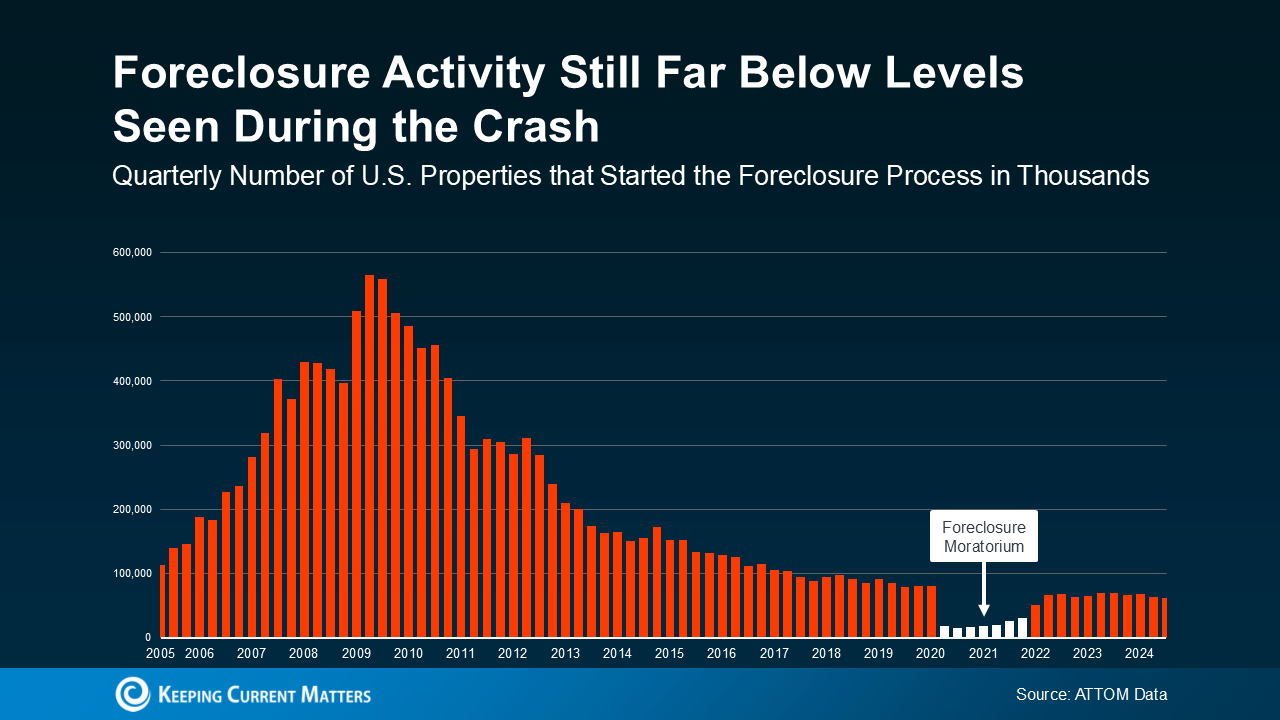 Just in case you’re wondering why the number of foreclosure filings has ticked up slightly since 2020 and 2021, here’s what you need to know. During those years, there was a moratorium (shown in white) designed to help millions of homeowners avoid foreclosure in challenging times. That’s why the numbers for just a few years ago were so incredibly low. If you look further back, it’s clear overall foreclosure filings are down significantly.
And if you’re wondering: how are there fewer foreclosures today, even when the cost of living has gotten so pricey? Here’s your answer. One of the main reasons is that homeowners today have a lot more equity built up in their homes than they did back in 2008. As an article from Bankrate explains:
“In the years after the housing crash, millions of foreclosures flooded the housing market, depressing prices. That’s not the case now. Most homeowners have a comfortable equity cushion in their homes.”
This equity acts like a safety net and is allowing many homeowners to avoid going into foreclosure if they’re facing financial hardships. Even if someone is struggling to make their monthly payments, they may be able to sell their home and avoid foreclosure altogether. This is a far cry from the conditions during the crash when homeowners owed more on their mortgages than their homes were worth.
What’s Ahead for the Housing Market
It’s true that today’s higher cost of living across the board is a challenge for many people right now. But this doesn’t mean we’re heading for a surge in foreclosures.
The equity cushion that people have is helping to keep foreclosure filings low. Today’s homeowners have more options to avoid going into foreclosure.
Bottom Line
Yes, everyday costs for gas and food have gotten more expensive—but that doesn’t mean the housing market is on the brink of another foreclosure crisis. Data shows the market is far from a foreclosure wave. Homeowners today are in a much stronger financial position than they were during the 2008 crash, thanks to significant equity.

by Cedar Point Realty | Aug 2, 2024 | Foreclosures, Infographic, Inventory
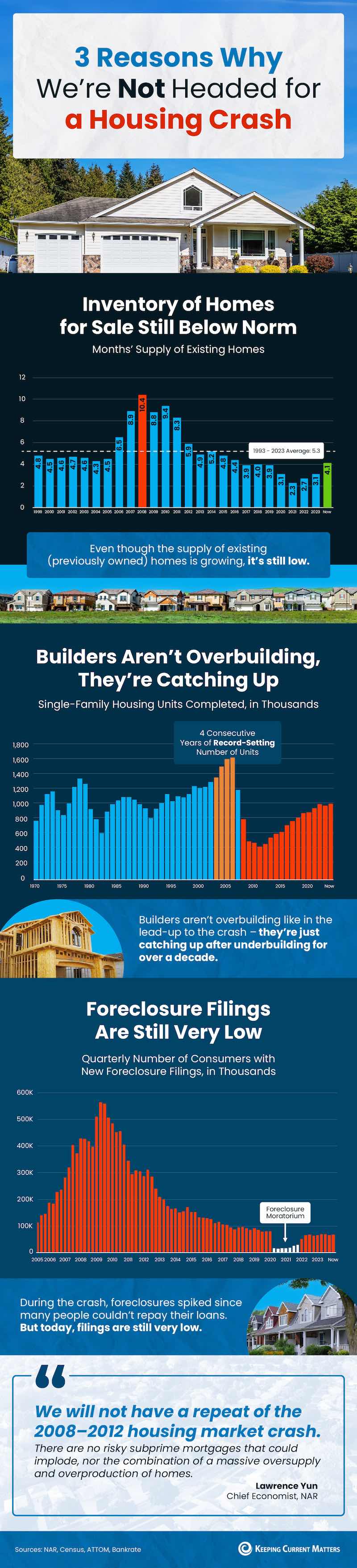
Some Highlights
- Back in 2008, there was an oversupply of homes for sale. Today, there’s an undersupply. The three main sources of inventory show this isn’t like the last time.
- Existing homes, new homes, and foreclosures are all way below the levels we saw during the housing crash.
- Inventory data shows there just aren’t enough homes available to have a repeat of what happened back in 2008.

by Cedar Point Realty | Jul 23, 2024 | Forecasts, Foreclosures
Even though data shows inflation is cooling, a lot of people are still feeling the pinch on their wallets. And those high costs on everything from gas to groceries are fueling unnecessary concerns that more people are going to have trouble making their mortgage payments. But, does that mean there’s a big wave of foreclosures coming?
Here’s a look at why the data and the experts say that’s not going to happen.
There Aren’t Many Homeowners Who Are Seriously Behind on Their Mortgages
One of the main reasons there were so many foreclosures during the last housing crash was because relaxed lending standards made it easy for people to take out mortgages, even when they couldn’t show they’d be able to pay them back. At that time, lenders weren’t being as strict when looking at applicant credit scores, income levels, employment status, and debt-to-income ratio.
But since then, lending standards have gotten a whole lot tighter. Lenders became much more diligent when assessing applicants for home loans. And that means we’re seeing more qualified buyers who have less of a risk of defaulting on their loans.
That’s why data from Freddie Mac and Fannie Mae shows the number of homeowners who are seriously behind on their mortgage payments (known in the industry as delinquencies) has been declining for quite some time. Take a look at the graph below: 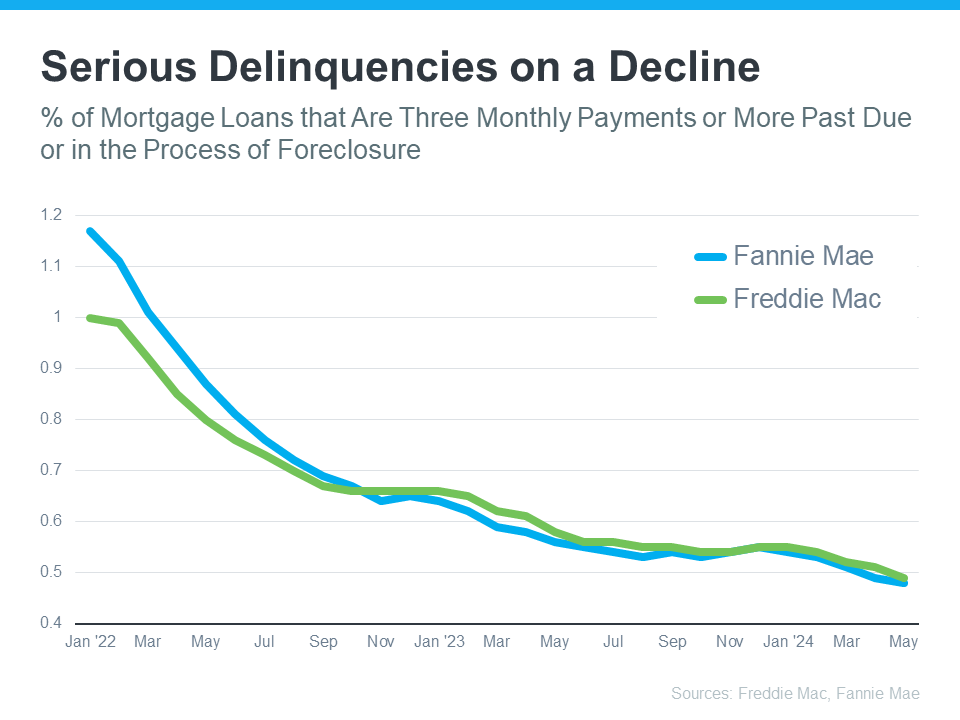
What this means is that, not only are borrowers more qualified, but they’re also finding ways to navigate through their challenges, exploring their repayment options, or maybe even using the record amount of equity they have to sell and avoid foreclosure entirely.
The Answer Is: There’s No Sign of a Wave Coming
Before there can be a significant rise in foreclosures, the number of people who can’t make their mortgage payments would need to rise significantly. But, since so many buyers are making their payments today and homeowners have so much equity built up, a wave of foreclosures isn’t likely.
Take it from Bill McBride of Calculated Risk – an expert on the housing market who, after closely following the data and market leading up to the crash, was able to see the foreclosure crisis coming in 2008. McBride says:
“We will NOT see a surge in foreclosures that would significantly impact house prices (as happened following the housing bubble) for two key reasons: 1) mortgage lending has been solid, and 2) most homeowners have substantial equity in their homes.”
Bottom Line
If you’re worried about a potential foreclosure crisis, know there’s nothing in the data to suggest that’ll happen. Buyers are more qualified now, and that’s one reason why they’re not falling seriously behind on their mortgage payments.

by Cedar Point Realty | Jul 8, 2024 | Economy, Foreclosures, Inventory
Even if you didn’t own a home at the time, you probably remember the housing crisis in 2008. That crash impacted the lives of countless people, and many now live with the worry that something like that could happen again. But rest easy, because things are different than they were back then. As Business Insider says:
“Though many Americans believe the housing market is at risk of crashing, the economists who study housing market conditions overwhelmingly do not expect a crash in 2024 or beyond.”
Here’s why experts are so confident. For the market (and home prices) to crash, there would have to be too many houses for sale, but the data doesn’t show that’s happening. Right now, there’s an undersupply, not an oversupply like the last time – and that’s true even with the inventory growth we’ve seen this year. You see, the housing supply comes from three main sources:
- Homeowners deciding to sell their houses (existing homes)
- New home construction (newly built homes)
- Distressed properties (foreclosures or short sales)
And if we look at those three main sources of inventory, you’ll see it’s clear this isn’t like 2008.
Homeowners Deciding To Sell Their Houses
Although the supply of existing (previously owned) homes is up compared to this time last year, it’s still low overall. And while this varies by local market, nationally, the current months’ supply is well below the norm, and even further below what we saw during the crash. The graph below shows this more clearly.
If you look at the latest data (shown in green), compared to 2008 (shown in red), we only have about a third of that available inventory today. 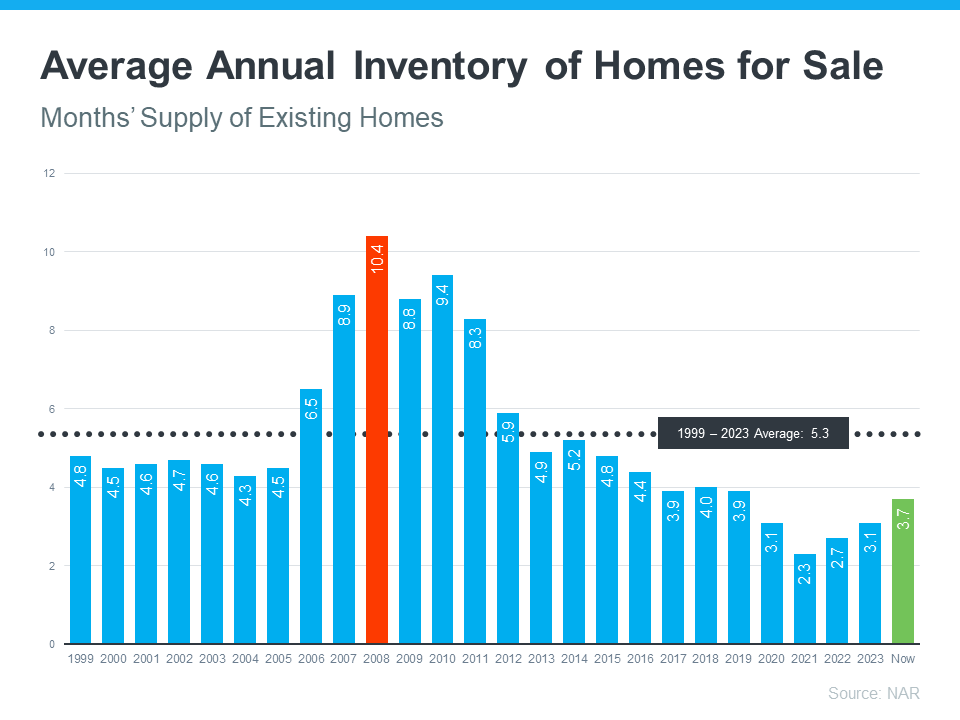
So, what does this mean? There just aren’t enough homes available to make values drop. To have a repeat of 2008, there’d need to be a lot more people selling their houses with very few buyers, and that’s not the case right now.
New Home Construction
People are also talking a lot about what’s going on with newly built houses these days, and that might make you wonder if homebuilders are overdoing it. Even though new homes make up a larger percentage of the total inventory than the norm, there’s no need for alarm. Here’s why.
The graph below uses data from the Census to show the number of new houses built over the last 52 years. The orange on the graph shows the overbuilding that happened in the lead-up to the crash. And, if you look at the red in the graph, you’ll see that builders have been underbuilding pretty consistently since then: 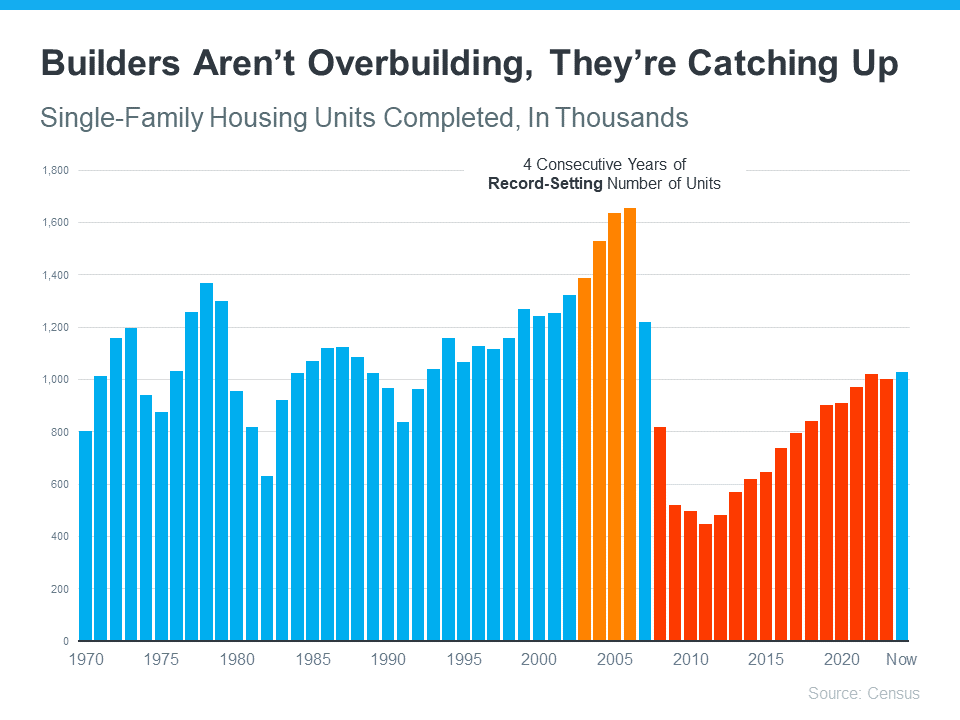
There’s just too much of a gap to make up. Builders aren’t overbuilding today, they’re catching up. A recent article from Bankrate says:
“What’s more, builders remember the Great Recession all too well, and they’ve been cautious about their pace of construction. The result is an ongoing shortage of homes for sale.”
Distressed Properties (Foreclosures and Short Sales)
The last place inventory can come from is distressed properties, including short sales and foreclosures. During the housing crisis, there was a flood of foreclosures due to lending standards that allowed many people to get a home loan they couldn’t truly afford.
Today, lending standards are much tighter, resulting in more qualified buyers and far fewer foreclosures. The graph below uses data from ATTOM to show how things have changed since the housing crash: 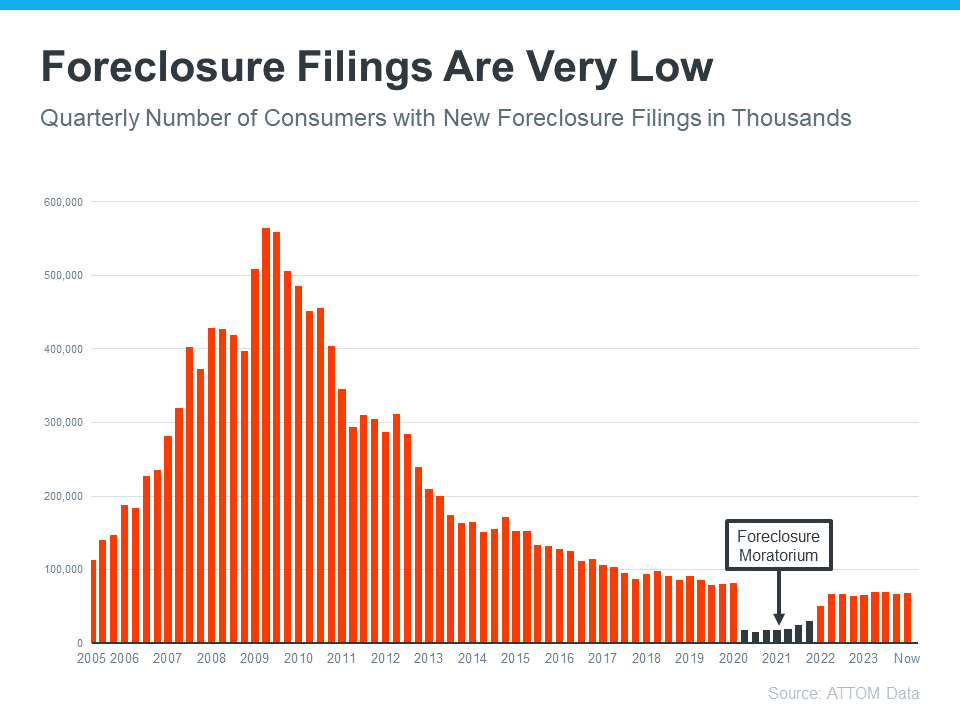
This graph makes it clear that as lending standards got tighter and buyers became more qualified, the number of foreclosures started to go down. And in 2020 and 2021, the combination of a moratorium on foreclosures (shown in black) and the forbearance program helped prevent a repeat of the wave of foreclosures we saw when the market crashed.
While you may see headlines that foreclosure volume is ticking up – remember, that’s only compared to recent years when very few foreclosures happened. We’re still below the normal level we’d see in a typical year.
What This Means for You
Inventory levels aren’t anywhere near where they’d need to be for prices to drop significantly and the housing market to crash. As Forbes explains:
“As already-high home prices continue trending upward, you may be concerned that we’re in a bubble ready to pop. However, the likelihood of a housing market crash—a rapid drop in unsustainably high home prices due to waning demand—remains low for 2024.”
Mark Fleming, Chief Economist at First American, points to the laws of supply and demand as a reason why we aren’t headed for a crash:
“There’s just generally not enough supply. There are more people than housing inventory. It’s Econ 101.”
And Lawrence Yun, Chief Economist at the National Association of Realtors (NAR), says:
“We will not have a repeat of the 2008–2012 housing market crash. There are no risky subprime mortgages that could implode, nor the combination of a massive oversupply and overproduction of homes.”
Bottom Line
The market doesn’t have enough available homes for a repeat of the 2008 housing crisis – and there’s nothing that suggests that will change anytime soon. That’s why housing experts and inventory data tell us there isn’t a crash on the horizon.
