
by Cedar Point Realty | Mar 12, 2025 | Forecasts
In today’s real estate market, high mortgage rates have left many would-be homebuyers waiting for rates to drop. However, waiting for interest rates to fall could mean missing out on current opportunities. If you’re eager to buy a home but don’t want to wait for lower rates, there are several strategies to help you navigate high mortgage rates and make a smart home purchase. Here’s how you can buy a home today without waiting for lower rates.
1. Consider an Adjustable-Rate Mortgage (ARM)
If you’re concerned about high interest rates, an Adjustable-Rate Mortgage (ARM) might be an excellent option. ARMs offer a lower initial interest rate compared to fixed-rate mortgages, typically for the first 5, 7, or 10 years. After the initial period, the rate adjusts based on market conditions.
With an ARM, you can benefit from a lower monthly payment at the start, and if rates eventually drop, you can refinance or sell before the adjustment period begins. This strategy helps reduce your immediate financial burden while giving you flexibility in the future.
2. Buy Now, Refinance Later
If you’re buying a home now and worried about high rates, consider the option to buy now and refinance later. This strategy allows you to lock in a home at today’s rates and refinance your mortgage when rates drop in the future.
Although refinancing comes with some costs, such as closing fees, it can be a worthwhile investment if rates decrease. By refinancing, you could lower your monthly payments and save money over the life of the loan, making this a smart move for long-term homeownership.
3. Buy a Smaller or Less Expensive Home
One way to offset high mortgage rates is to buy a smaller or less expensive home. A smaller home or a property in a more affordable area can lower your mortgage amount and reduce your monthly payments, helping you manage the impact of high interest rates.
By adjusting your expectations and focusing on homes within your budget, you can still find a property that suits your needs while keeping your mortgage payments manageable.
4. Make a Larger Down Payment
A larger down payment can significantly reduce the size of your loan, which in turn lowers your interest payments. By putting down 20% or more, you may also avoid private mortgage insurance (PMI), further reducing your monthly costs.
Making a larger down payment helps minimize the impact of higher mortgage rates, making your monthly payments more affordable and giving you a better chance of securing favorable loan terms.
5. Shop Around for the Best Mortgage Rates
Not all mortgage lenders offer the same rates. It’s crucial to shop around for the best mortgage rates. Even a small difference in rates can have a significant effect on your monthly payment and the total cost of your loan over time.
Take the time to compare offers from multiple lenders, including banks, credit unions, and online lenders. Also, consider looking at other factors, such as fees and terms, to ensure you’re getting the best deal available.
6. Negotiate Closing Costs and Fees
When buying a home, closing costs and fees can add up quickly. However, many of these costs are negotiable. Work with your lender to see if they’re willing to reduce or waive certain fees to make your home purchase more affordable.
Additionally, you can ask the seller to cover some of your closing costs, especially if the property has been on the market for a while or the seller is motivated to close quickly. Reducing your upfront costs can help offset the financial strain of higher mortgage rates.
7. Consider a Buydown Option
A rate buydown is another option for lowering your mortgage rate. With a rate buydown, you pay extra upfront to reduce your interest rate for a set period, such as the first 3, 2, or 1 years. For example, in a 3-2-1 buydown, your interest rate is reduced by 3% in the first year, 2% in the second year, and 1% in the third year before it returns to the original rate.
While a buydown can help you manage your payments in the short term, be sure to consider the upfront cost and whether it fits your long-term financial goals. A buydown could work well if you plan to sell or refinance before the rate adjusts.
8. Look for Seller Financing
In some situations, seller financing may be a viable option. With seller financing, the seller acts as the lender, allowing you to make payments directly to them instead of going through a traditional mortgage lender. Seller financing often comes with more flexible terms, which could include a lower interest rate.
While seller financing can be attractive, it’s essential to carefully review the terms and consult with a real estate attorney to ensure that the deal is fair and legal.
9. Focus on Long-Term Investment Potential
Despite the high mortgage rates, buying a home now can still be a sound long-term investment. Real estate typically appreciates over time, and by purchasing a home now, you can benefit from future property value increases.
Focusing on the long-term potential of homeownership can help you stay motivated despite higher interest rates. As the market evolves, your home’s value may rise, helping you build equity and wealth over the years.
Conclusion
You don’t have to wait for lower interest rates to buy a home. By considering options like Adjustable-Rate Mortgages (ARMs), refinancing later, buying a smaller home, and making a larger down payment, you can navigate the current real estate market and secure your dream home today.
Each strategy allows you to manage the impact of higher mortgage rates while making a smart financial decision. Work with a trusted real estate agent and mortgage broker to explore these options and find the best solution for your situation. Don’t let higher rates stop you from homeownership—take action now and set yourself up for success in the long run.

by Cedar Point Realty | Dec 4, 2024 | Forecasts, Mortgage Rates
One of the biggest questions on everyone’s minds right now is: when will mortgage rates come down? After several years of rising rates and a lot of bouncing around in 2024, we’re all eager for some relief. While no one can project where rates will go with complete accuracy or the exact timing, experts offer some insight into what we might see going into next year. Here’s what the latest forecasts show.
Mortgage Rates Are Expected to Ease and Stabilize in 2025
After a lot of volatility and uncertainty, the most updated forecasts suggest that mortgage rates will start to stabilize over the next year, and should ease a bit compared to where they are right now. According to Lawrence Yun, Chief Economist at the National Association of Realtors (NAR), “While mortgage rates remain elevated, they are expected to stabilize.”
As we move into 2025, many experts expect mortgage rates to gradually decrease, which will provide some relief for homebuyers and homeowners looking to refinance. Though these predictions are based on current data, the timeline and pace of the decline are still uncertain due to the influence of various factors in the broader economy.
Key Factors That’ll Impact the Future of Mortgage Rates
While most forecasts show that mortgage rates will ease over time, it’s important to recognize that predicting exactly when and by how much is incredibly difficult. Mortgage rates are affected by numerous economic variables, making them a moving target. Here are a few key factors that will likely shape the future of mortgage rates:
1. Inflation
Inflation remains a major driver of mortgage rates. If inflation continues to cool, there’s a higher chance that rates will dip further. On the other hand, if inflation remains stubbornly high or increases again, rates could stay elevated longer than expected. Inflationary pressure is a major concern for the Federal Reserve, which adjusts interest rates to try and stabilize the economy, and its actions influence mortgage rates.
2. Unemployment Rate
The unemployment rate plays a significant role in decisions made by the Federal Reserve (the Fed). While the Fed does not directly set mortgage rates, its monetary policies—based on broader economic conditions like employment—can influence how rates move. If the job market remains strong and the unemployment rate stays low, the Fed may continue to implement measures that could lead to more stable rates. However, if unemployment rises, the Fed may take different actions, which could impact rates.
3. Government Policies
With the upcoming change in administration and fiscal policies set to be re-evaluated starting in January, we could see shifts in how financial markets respond. New policies could influence the overall economy, which in turn will affect where mortgage rates are heading. Government fiscal actions and monetary policies will likely play a critical role in determining the direction of mortgage rates throughout 2025.
4. Global Economic Conditions
Global events, such as geopolitical developments or economic crises in other parts of the world, can also affect mortgage rates. Any global economic instability could lead to shifts in investor behavior, affecting interest rates in the U.S. as investors respond to broader economic conditions.
What Can Homebuyers and Homeowners Do Now?
While the future of mortgage rates remains uncertain, there are steps you can take right now to prepare, regardless of where rates go.
Focus on What You Can Control:
- Improve Your Credit Score: A higher credit score can help you secure a lower mortgage rate when the time comes. Take steps now to improve your credit by paying off debt and keeping credit card balances low.
- Save for a Down Payment: The more you can save for a down payment, the better positioned you’ll be when rates do ease. A larger down payment can also help you secure better loan terms.
- Automate Your Savings: Set up automatic transfers to a savings account to help you build up funds for your future home purchase.
These steps will ensure that you’re ready when mortgage rates begin to dip, allowing you to move forward with your homeownership goals.
Bottom Line
While no one can predict exactly when mortgage rates will come down or how far they will fall, most experts agree that they will likely stabilize and ease in 2025. Key factors like inflation, unemployment rates, and government policies will play major roles in determining the timing and scale of any changes. In the meantime, focus on your financial readiness and stay connected with trusted real estate agents and lenders to get the most up-to-date advice and guidance. By preparing now, you’ll be in a stronger position to act when rates finally dip.

by Cedar Point Realty | Aug 28, 2024 | Buyers & Sellers, Forecasts, Home Prices, Mortgage Rates
Looking ahead to 2025, it’s important to know what experts are projecting for the housing market. And whether you’re thinking of buying or selling a home next year, having a clear picture of what they’re calling for can help you make the best possible decision for your homeownership plans.
Here’s an early look at the most recent projections on mortgage rates, home sales, and prices for 2025.
Mortgage Rates Are Projected To Come Down Slightly
Mortgage rates play a significant role in the housing market. The forecasts for 2025 from Fannie Mae, the Mortgage Bankers Association (MBA), the National Association of Realtors (NAR), and Wells Fargo show an expected gradual decline in mortgage rates over the course of the next year (see chart below):
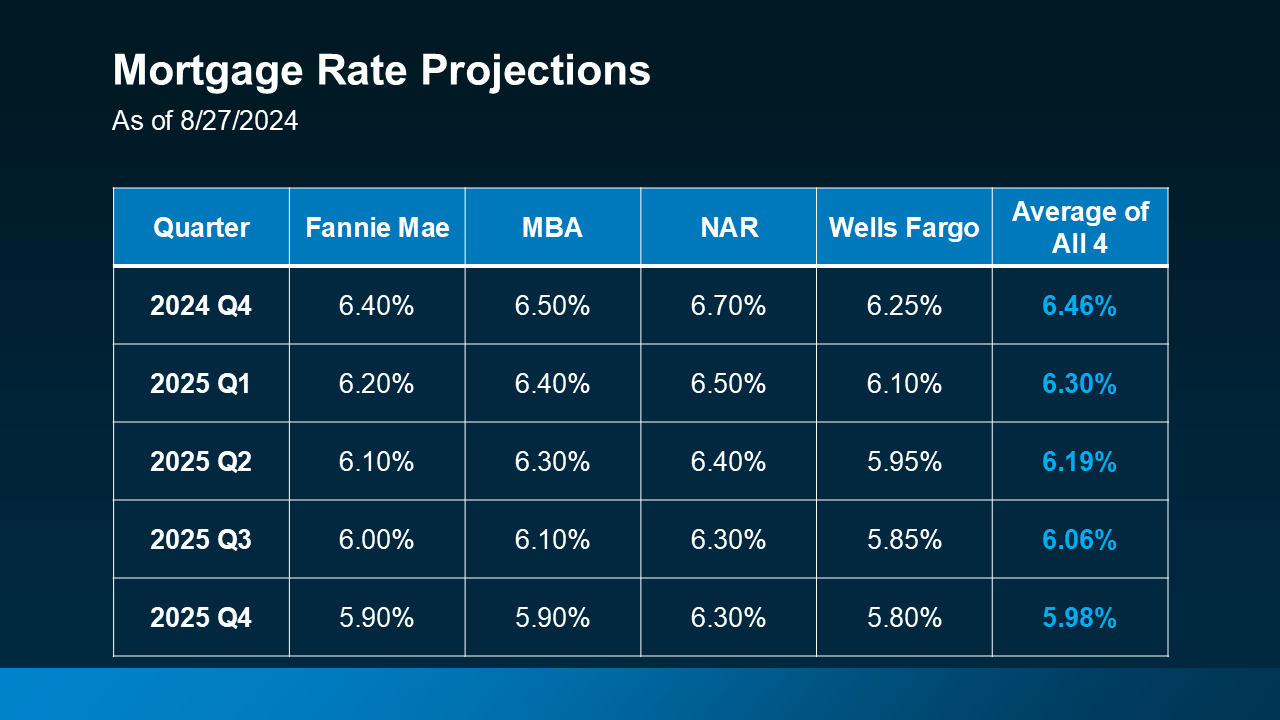 Mortgage rates are projected to come down because continued easing of inflation and a slight rise in unemployment rates are key signs of a strong but slowing economy. And many experts believe these signs will encourage the Federal Reserve to lower the Federal Funds Rate, which tends to lead to lower mortgage rates. As Morgan Stanley says:
“With the U.S. Federal Reserve widely expected to begin cutting its benchmark interest rate in 2024, mortgage rates could drop as well—at least slightly.”
Expect More Homes To Sell
The market will see an increase in both the supply of available homes on the market, as well as a rise in demand, as more buyers and sellers who have been sitting on the sidelines because of higher rates choose to make a move. That’s one big reason why experts are projecting an increase in home sales next year.
According to Fannie Mae, MBA, and NAR, total home sales are forecast to climb slightly, with an average of about 5.4 million homes expected to sell in 2025 (see graph below):
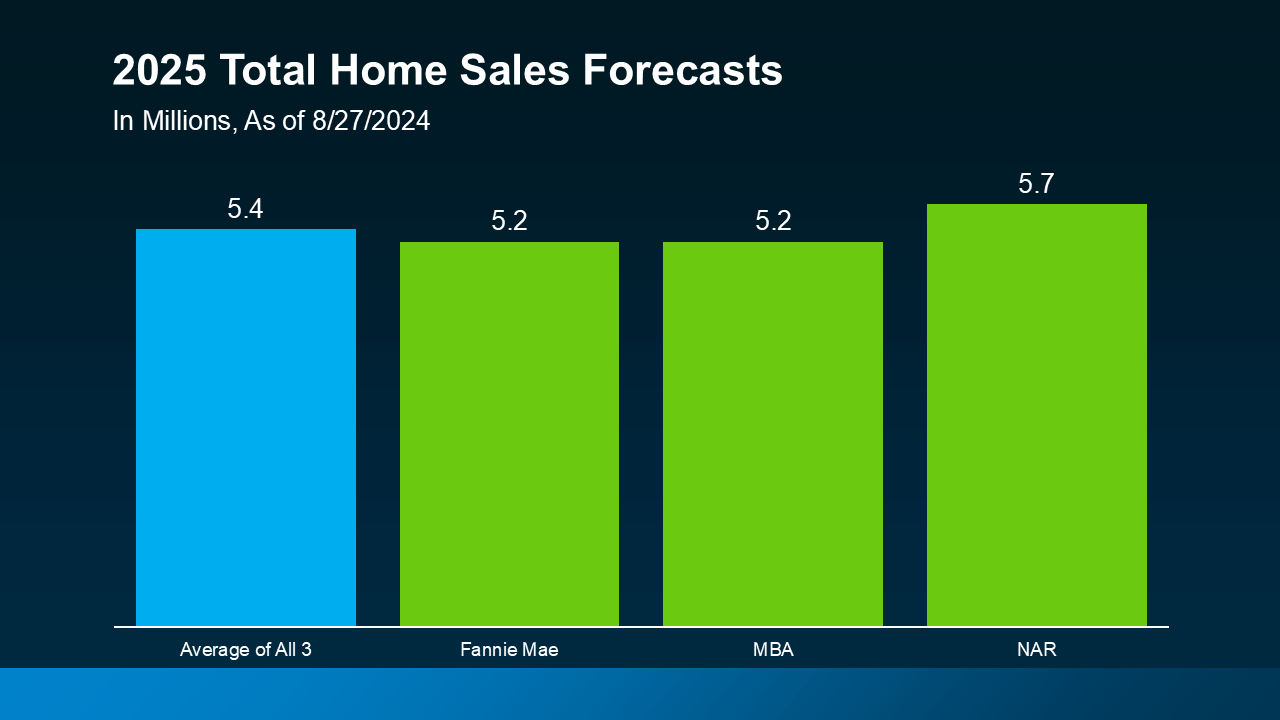 That would represent a modest uptick from the lower sales numbers in 2023 and 2024. For reference, about 4.8 million total homes were sold in 2023, and expectations are for around 4.5 million homes to sell this year.
While slightly lower mortgage rates are not expected to bring a flood of buyers and sellers back to the market, they certainly will get more people moving. That means more homes available for sale – and competition among buyers who want to purchase them.
Home Prices Will Go Up Moderately
More buyers ready to jump into the market will put continued upward pressure on prices. Take a look at the latest price forecasts from 10 of the most trusted sources in real estate (see graph below):
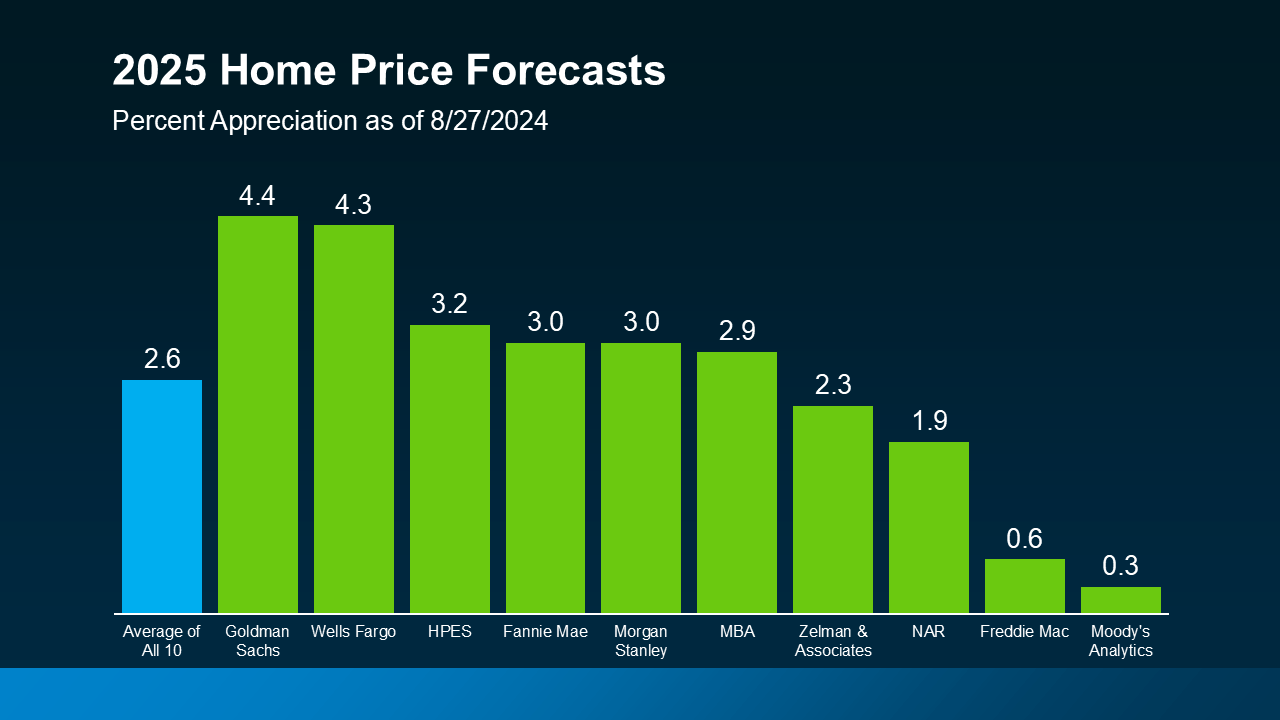 On average, experts forecast home prices will rise nationally by about 2.6% next year. But as you can see, there’s a range of opinions on how much prices will climb. Experts agree, however, that home prices will continue to increase moderately next year at a slower, more normal rate. But keep in mind, prices will always vary by local market.
Bottom Line
Understanding 2025 housing market forecasts can help you plan your next move. Whether you’re buying or selling, staying informed about these trends will ensure you make the best decision possible. Reach out to a trusted real estate agent to discuss how these forecasts could impact your plans.

by Cedar Point Realty | Jul 23, 2024 | Forecasts, Foreclosures
Even though data shows inflation is cooling, a lot of people are still feeling the pinch on their wallets. And those high costs on everything from gas to groceries are fueling unnecessary concerns that more people are going to have trouble making their mortgage payments. But, does that mean there’s a big wave of foreclosures coming?
Here’s a look at why the data and the experts say that’s not going to happen.
There Aren’t Many Homeowners Who Are Seriously Behind on Their Mortgages
One of the main reasons there were so many foreclosures during the last housing crash was because relaxed lending standards made it easy for people to take out mortgages, even when they couldn’t show they’d be able to pay them back. At that time, lenders weren’t being as strict when looking at applicant credit scores, income levels, employment status, and debt-to-income ratio.
But since then, lending standards have gotten a whole lot tighter. Lenders became much more diligent when assessing applicants for home loans. And that means we’re seeing more qualified buyers who have less of a risk of defaulting on their loans.
That’s why data from Freddie Mac and Fannie Mae shows the number of homeowners who are seriously behind on their mortgage payments (known in the industry as delinquencies) has been declining for quite some time. Take a look at the graph below: 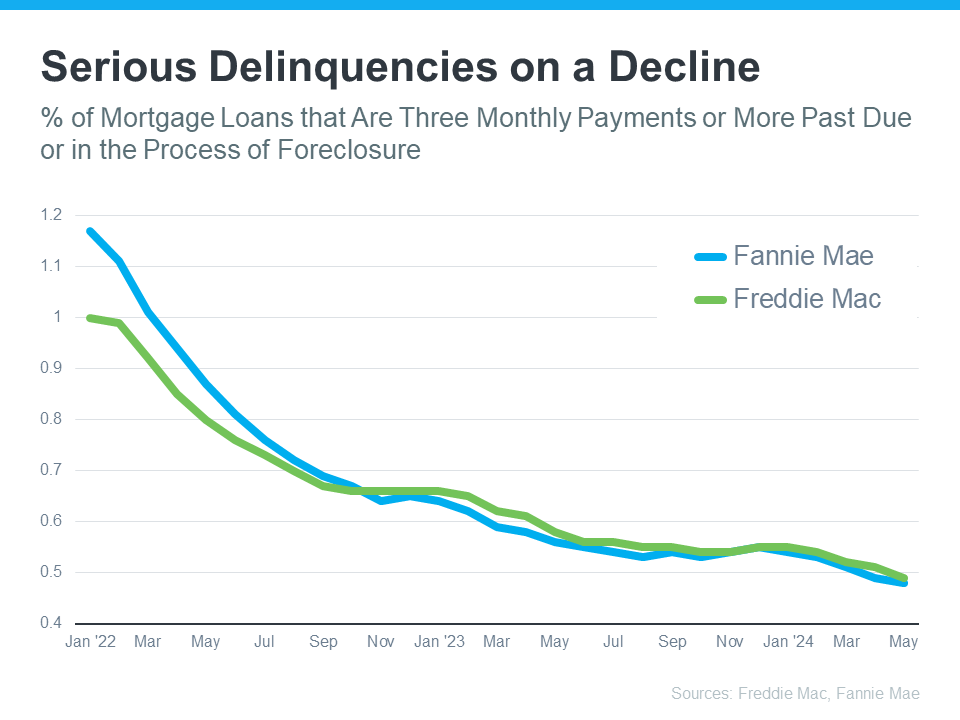
What this means is that, not only are borrowers more qualified, but they’re also finding ways to navigate through their challenges, exploring their repayment options, or maybe even using the record amount of equity they have to sell and avoid foreclosure entirely.
The Answer Is: There’s No Sign of a Wave Coming
Before there can be a significant rise in foreclosures, the number of people who can’t make their mortgage payments would need to rise significantly. But, since so many buyers are making their payments today and homeowners have so much equity built up, a wave of foreclosures isn’t likely.
Take it from Bill McBride of Calculated Risk – an expert on the housing market who, after closely following the data and market leading up to the crash, was able to see the foreclosure crisis coming in 2008. McBride says:
“We will NOT see a surge in foreclosures that would significantly impact house prices (as happened following the housing bubble) for two key reasons: 1) mortgage lending has been solid, and 2) most homeowners have substantial equity in their homes.”
Bottom Line
If you’re worried about a potential foreclosure crisis, know there’s nothing in the data to suggest that’ll happen. Buyers are more qualified now, and that’s one reason why they’re not falling seriously behind on their mortgage payments.
![Housing Market Forecast for the 2nd Half of 2024 [INFOGRAPHIC]](https://www.upnorthpropertysearch.com/wp-content/uploads/sites/34/2024/06/Housing-Market-Forecast-for-the-2nd-Half-of-2024-NM.jpg)
by Cedar Point Realty | Jun 28, 2024 | Forecasts, Home Prices, Infographic, Mortgage Rates
Some Highlights

by Cedar Point Realty | Jun 24, 2024 | For Buyers, For Sellers, Forecasts, Home Prices, Inventory
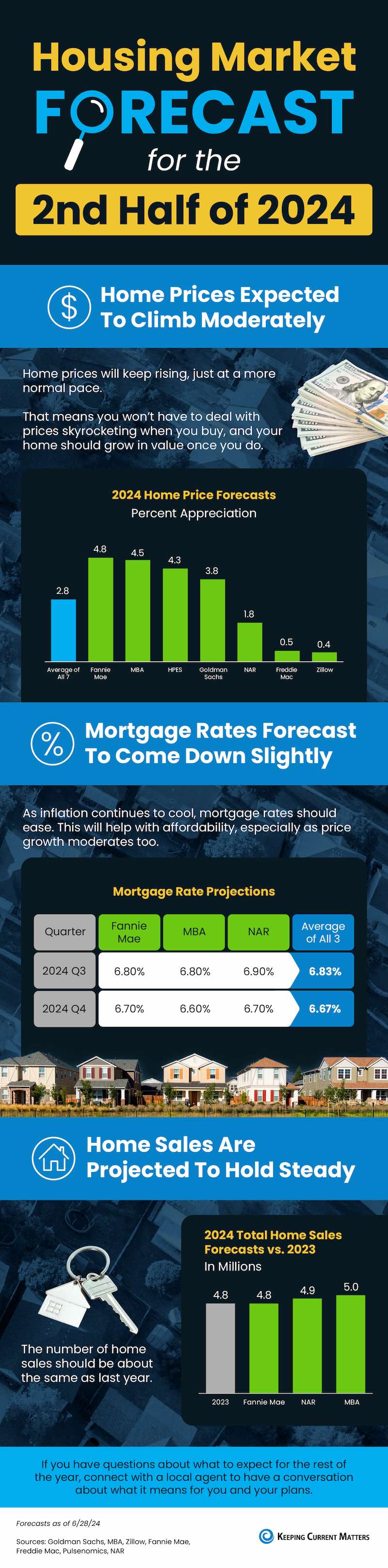
As we move into the second half of 2024, here’s what experts say you should expect for home prices, mortgage rates, and home sales.
Home Prices Are Expected To Climb Moderately
Home prices are forecasted to rise at a more normal pace. The graph below shows the latest forecasts from seven of the most trusted sources in the industry:
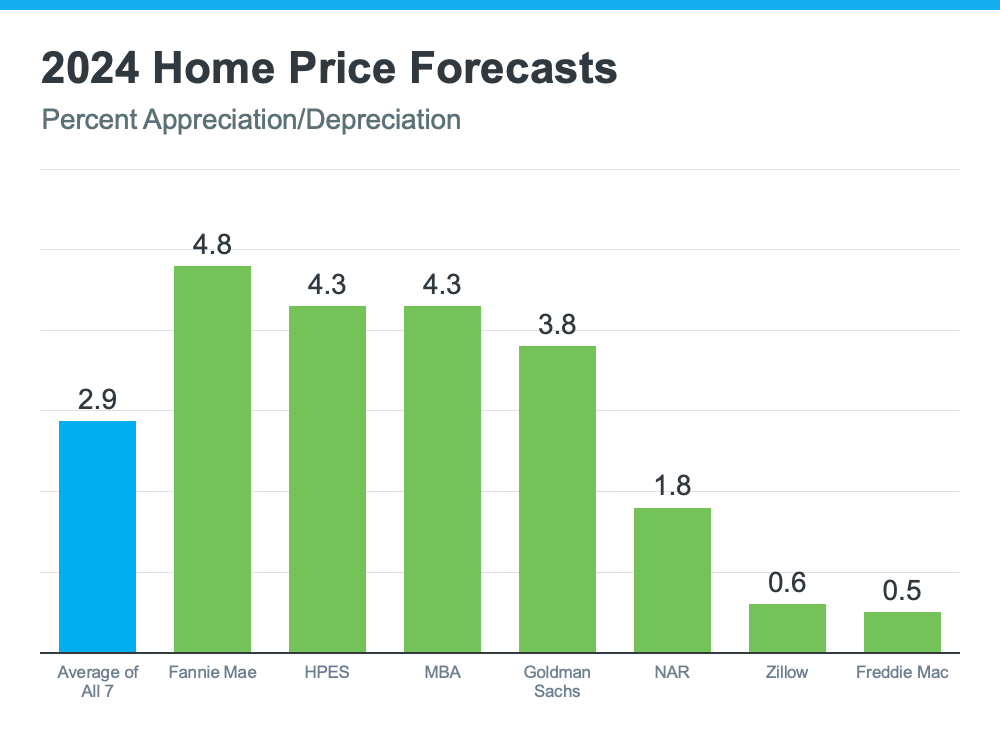
The reason for continued appreciation? The supply of homes for sale. Jessica Lautz, Deputy Chief Economist at the National Association of Realtors (NAR), explains:
“One thing that seems to be pretty solid is that home prices are going to continue to go up, and the reason is that we don’t have housing inventory.”
While inventory is up compared to the last couple of years, it’s still low overall. And because there still aren’t enough homes to go around, that’ll keep upward pressure on prices.
If you’re thinking of buying, the good news is you won’t have to deal with prices skyrocketing like they did during the pandemic. Just remember, prices aren’t expected to drop. They’ll continue climbing, just at a slower pace.
So, getting into the market sooner rather than later could still save you money in the long run. Plus, you can feel confident experts say your home will grow in value after you buy it.
Mortgage Rates Are Forecast To Come Down Slightly
One of the best pieces of news for both buyers and sellers is that mortgage rates are expected to come down a bit, according to Fannie Mae, the Mortgage Bankers Association (MBA), and NAR (see chart below):
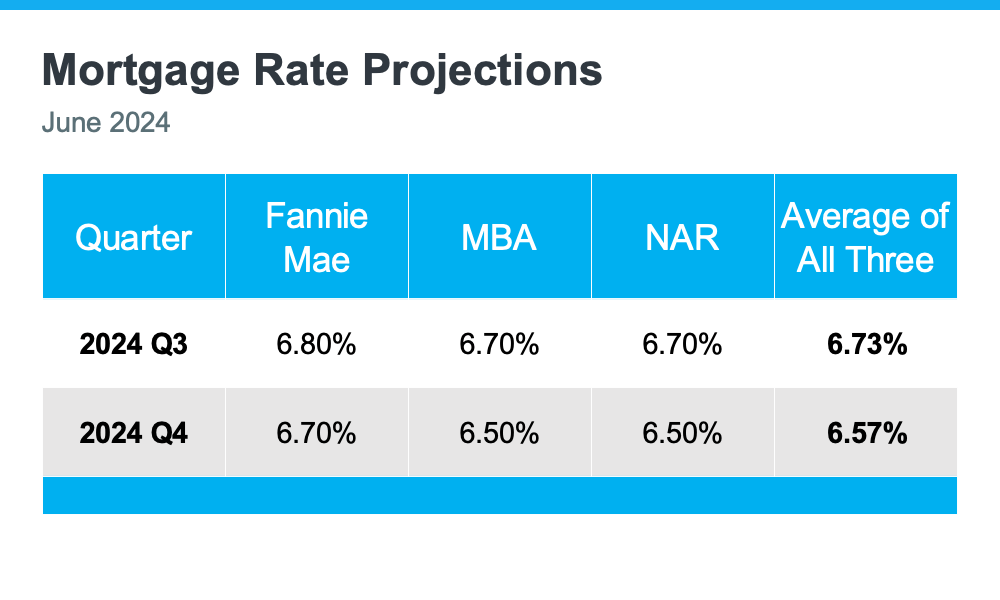 When you buy, even a small drop in mortgage rates can make a big difference in your monthly payments. For sellers, lower rates will bring more buyers back into the market, which can help you sell faster and potentially at a higher price. Plus, it may help you get off the fence, if you’ve been hesitant to sell due to today’s rates.
Home Sales Are Projected To Hold Steady
For 2024, the number of home sales will be about the same as last year and may even rise slightly. The graph below compares the 2024 home sales forecasts from Fannie Mae, MBA, and NAR to the 4.8 million homes that sold last year:
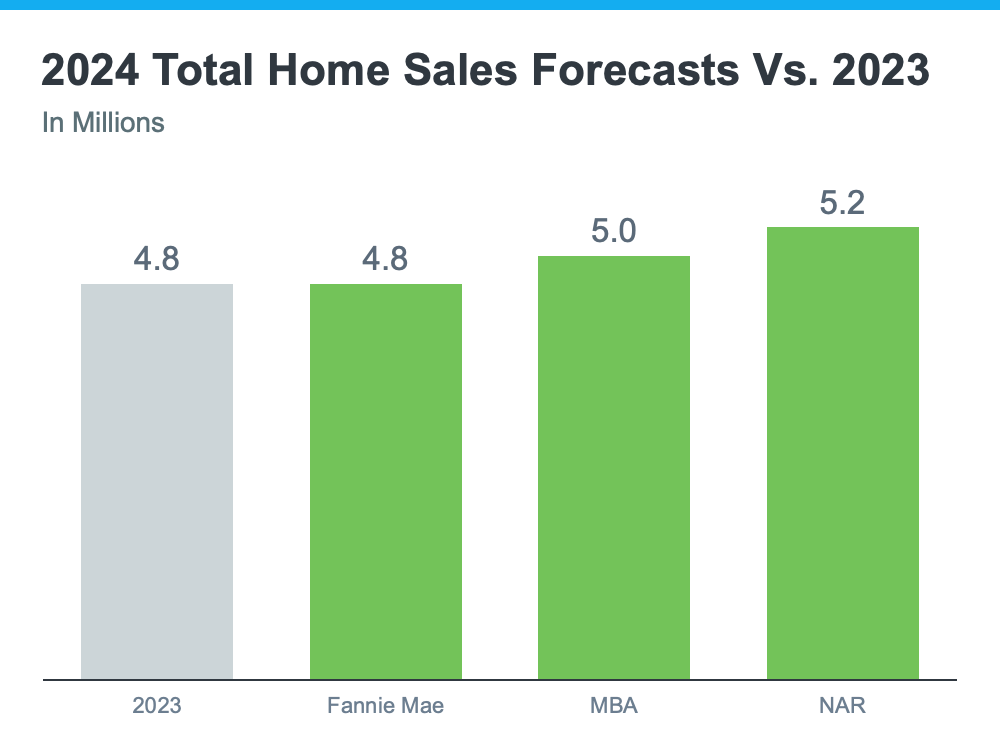
The average of the three forecasts is about 5 million sales in 2024 – a small increase from 2023. Lawrence Yun, Chief Economist at NAR, explains why:
“Job gains, steady mortgage rates and the release of inventory from pent-up home sellers will lead to more sales.”
With more inventory available and mortgage rates expected to go down, a few more homes are expected to be sold this year compared to last year. This means more people will be able to move. Let’s work together to make sure you’re one of them.
Bottom Line
If you have any questions or need help navigating the market, reach out to a local real estate agent.
